Skip to content
Calcipedia
Speed Calculator instructional illustration

Speed Calculator

Solve for speed, distance, or time with scenario presets, seconds-aware inputs, km/h, mph, m/s, knots, ft/s, pace, and travel-planning outputs.

Last updated

Speed-distance-time

Solve for speed, distance, or time from the constant-speed relationship, then review km/h, mph, m/s, knots, feet-per-second, and pace-style outputs in one place. This speed distance time calculator is built for quick travel planning, training maths, classroom motion problems, and broader unit conversion checks.

What this mode solves Use distance and total travel time to calculate average speed, then compare the answer across km/h, mph, m/s, knots, ft/s, and pace.
Solve for

Try a common example

Use these examples to sanity-check road-trip, running, sprint, and marine speed-distance-time setups before entering your own values.

Speed input unit
Distance input unit

Changing a unit converts the current value into the new unit instead of changing the physical meaning of the trip, effort, or motion problem you are solving.

Time

Distance presets

Time presets

Solved result

100 km/h

Average speed for 100 km in 1:00

100 km/h

Speed in kilometres per hour

62.14 mph

Speed in miles per hour

27.78 m/s

Speed in metres per second

54 kn

Speed in knots

91.13 ft/s

Speed in feet per second

0:36 / km

Equivalent pace per kilometre

Distance and time sheet

MeasureValueConverted value
Distance100 km62.14 mi
Time1:001 hours
Speed100 km/h62.14 mph

Pace and conversion context

OutputValueWhy it helps
Metres per second27.78 m/sUseful for physics, school work, and SI-unit checks.
Knots54 knUseful for boating, aviation, and transport comparisons.
Feet per second91.13 ft/sUseful for engineering and classroom motion problems.
Pace per kilometre0:36 / kmUseful for running, walking, and endurance pacing.
Pace per mile0:58 / miUseful when comparing imperial-distance training targets.

Travel-time planner at this speed

Target distanceTravel timeConverted distance
5 km0:033.11 mi
10 km0:066.21 mi
25 km0:1515.53 mi
50 km0:3031.07 mi

Distance you would cover at this speed

Time windowDistanceConverted distance
0:1525 km15.53 mi
0:3050 km31.07 mi
1:00100 km62.14 mi
2:00200 km124.27 mi
Average-speed reminder This calculator works with average speed at a constant-rate assumption. If the journey includes stops or major speed changes, the result is still the overall average, not the peak speed reached at any one moment.
← All Motion & Speed calculators

Physics Basics

Speed calculator: solve for speed, distance, time, and pace

The speed-distance-time relationship is one of the most fundamental equations in physics, transport planning, and everyday problem solving. This page also explains the main assumptions behind the speed calculator result, highlights the supporting figures shown by the calculator, and helps the reader use the estimate without overstating what a quick online tool can prove.

The speed-distance-time formula

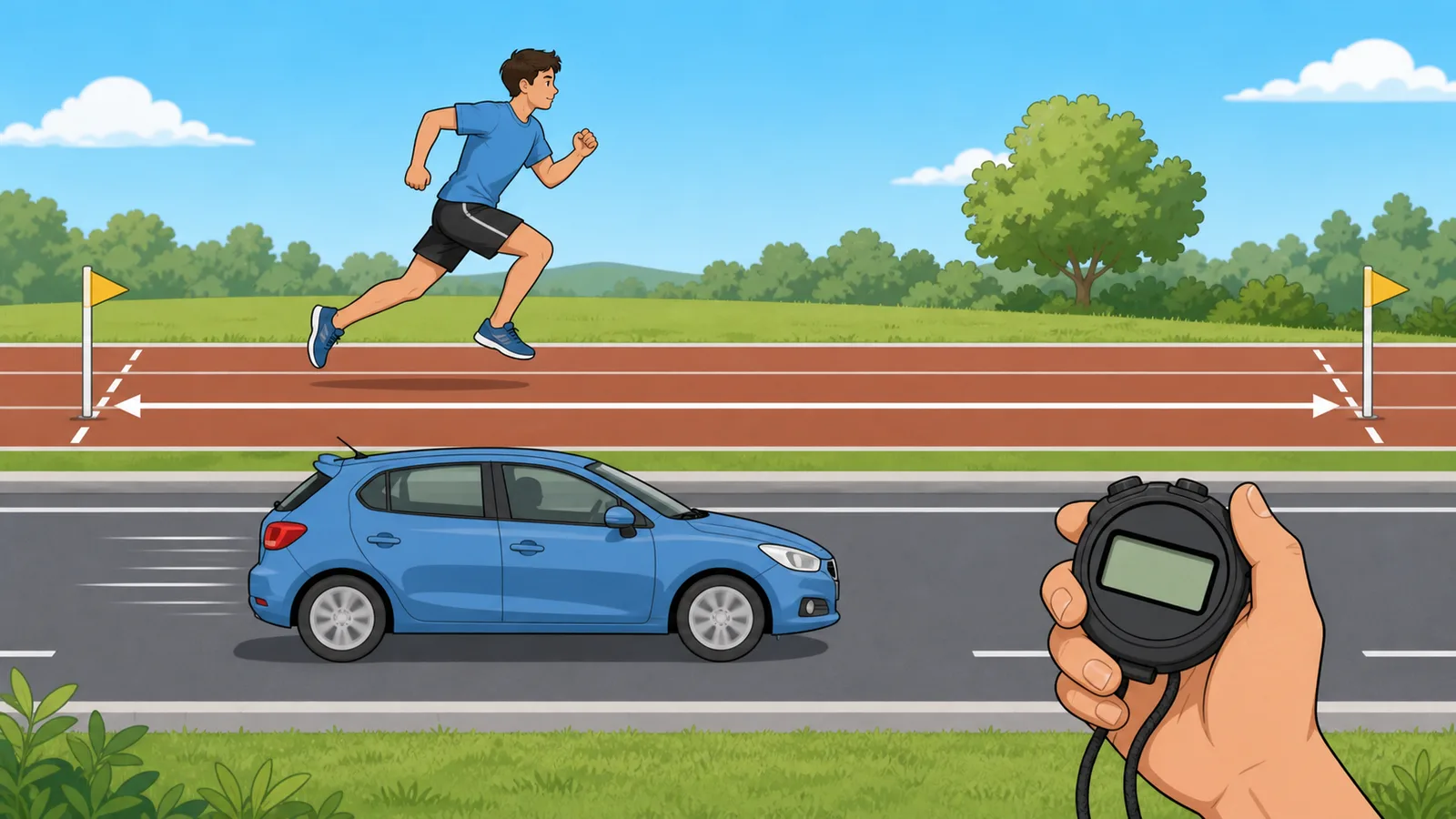
Speed is defined as the distance travelled divided by the time taken. Rearranging gives distance equals speed multiplied by time, and time equals distance divided by speed. These three forms cover every combination: if you know how fast something travels and for how long, you can find how far it went; if you know the distance and speed, you can find the time needed.

Average speed differs from instantaneous speed. A journey may average 70 mph or about 113 km/h including stops and slower sections, even if the vehicle briefly travels much faster. Average speed is total distance divided by total elapsed time, and that is the quantity this online speed calculator works with.

Speed = Distance / Time

Average speed equals total distance divided by total elapsed time.

Distance = Speed x Time

Distance covered equals speed multiplied by the time spent travelling.

Time = Distance / Speed

Time required equals total distance divided by average speed.

Unit conversion and practical applications

Converting between km/h and mph uses the factor 1 mile = 1.60934 kilometres. To convert km/h to mph, multiply by 0.621371. To convert mph to km/h, multiply by 1.60934. A speed of 100 km/h equals approximately 62.1 mph. Common reference speeds: walking is around 5 km/h, cycling averages 20 to 25 km/h, motorway driving is 100 to 130 km/h, and commercial aircraft cruise at about 900 km/h.

Speed calculations appear in fuel use analysis, athletic training, shipping logistics, and journey planning. A delivery vehicle averaging 60 km/h over 8 hours covers 480 km. A runner completing 10 km in 50 minutes has an average speed of 12 km/h and a pace of 5 minutes per kilometre. In physics, distinguishing between speed, which is scalar, and velocity, which includes direction, becomes important when movement changes course. That is why people also search for average speed, speed formula, find time from speed, or find distance from speed when the same maths needs to be applied to different scenarios.

When to use seconds, knots, feet per second, and pace

Hours-and-minutes inputs are usually enough for road trips, commuting, or logistics, but shorter motion problems often need seconds as well. If you are solving for sprinting, physics-class questions, short vehicle manoeuvres, or any journey measured in seconds, include the seconds part of the time so the result is not rounded too aggressively.

Different users also need different output units. Metres per second is the standard SI form used in physics. Knots are common in marine and aviation contexts. Feet per second is still useful in some engineering and classroom settings. Pace per kilometre and pace per mile are often easier to act on than km/h or mph when you are planning a run, walk, or endurance session. A practical speed distance time calculator should surface those views together rather than making you convert them manually.

That logic also applies to direct inputs. Short-track, sprint, or classroom problems often start with metres and seconds rather than kilometres and hours, while marine and aviation checks may start with nautical miles and knots. Letting the user enter those units directly removes one avoidable conversion step and makes the result sheet more trustworthy for the intent behind the search.

The example presets cover those common intents directly: a road trip in miles and hours, a 5K run with pace-style interpretation, a 100 metre sprint in metres and seconds, and a boat leg in nautical miles and knots. They are not separate formulas; they are sanity-check setups that show how the same speed-distance-time equation changes when the units and real-world context change.

Using one solved speed to plan ETA and distance covered

Once you know the average speed, the same number can answer two common follow-up questions: how long will a target distance take, and how far will I get in a fixed time window? That is why travel planners, delivery teams, runners, and cyclists often need more than a single speed output. If you are averaging 50 km/h, you can estimate a 25 km journey at about 30 minutes, or estimate that you would cover roughly 12.5 km in 15 minutes.

This planning step matters because average speed is easier to interpret when it is tied back to real distances or time windows. A headline result of 18 mph is useful, but a planner row showing what that means over 1 mile, 5 miles, 30 minutes, or 2 hours helps you make decisions. That is especially true when comparing route options, training sessions, or how much buffer to add before a meeting or delivery window.

Stops, segments, and average speed limits

A speed calculator gives an average for the values you enter. If your time input includes stops, traffic, waiting, or rest breaks, the result is a stop-inclusive average speed. If the time input only includes moving time, the result is a moving average. Both are valid, but they answer different planning questions.

For a multi-leg trip with different speeds on each segment, do not average the speeds directly. Add all the distances, add all the elapsed times, and then divide total distance by total time. If you need that segment-by-segment workflow, the related average speed calculator is a better fit, while this page is best for solving one missing speed, distance, or time variable and then converting the result.

Worked example: 100 km in 1 hour

If a journey covers 100 kilometres in 1 hour, the average speed is 100 km/h. That converts to about 62.1 mph or 27.8 m/s. The equivalent pace is 36 seconds per kilometre or about 58 seconds per mile.

That example shows why a better speed calculator should not stop at one headline number. People often need the same result in a different speed unit, in metres per second for physics work, or as a pace figure for training and event planning.

The same logic also supports ETA planning. At 100 km/h, a 50 km leg takes about 30 minutes, while a 10 km leg takes about 6 minutes. If the same result is expressed in imperial units, the trip speed is about 62.1 mph, so a 26.2-mile marathon-distance comparison would take just over 25 minutes at that pace. Those follow-on comparisons are often the real reason people search for a calculate speed or travel time from speed tool.

Further reading

Frequently asked questions

What is the speed, distance, time relationship?

Speed = Distance / Time. From this, Distance = Speed × Time and Time = Distance / Speed. These three relationships form the basis of all motion calculations at constant speed.

How do I convert between different speed units?

To convert km/h to mph, multiply by 0.6214. To convert mph to km/h, multiply by 1.6093. To convert km/h to m/s, divide by 3.6. To convert m/s to km/h, multiply by 3.6.

Is speed the same as velocity?

No. Speed is how fast something moves, while velocity includes direction as well. A car travelling 60 km/h east and 60 km/h west has the same speed but different velocity.

Does this calculator account for acceleration or deceleration?

No. The calculator assumes constant speed throughout the journey. For variable speed, average speed = total distance / total time, which the calculator can compute if you enter those two values directly.

What is average speed?

Average speed is total distance divided by total elapsed time. It is the value this calculator uses when you enter the distance and time for a trip or segment.

How do I calculate speed from distance and time?

Use the formula speed = distance / time. If you travel 120 kilometres in 2 hours, the average speed is 60 km/h. The important part is making sure the distance and time units match the output you want. If you use miles and hours, the result is mph. If you use metres and seconds, the result is m/s.

How do I find travel time from speed and distance?

Use time = distance / speed. If you need to travel 150 miles at an average speed of 50 mph, the journey takes 3 hours. For shorter trips or training efforts, including seconds can stop the answer from being rounded too broadly.

Can I use this speed calculator for pace?

Yes. Pace is just the inverse view of speed: instead of distance per time, it shows time per distance. That makes pace easier to use for running, walking, and endurance training. A good speed calculator should show pace per kilometre and pace per mile alongside km/h or mph so you can move between transport and training contexts easily.

Can I enter metres, feet, or nautical miles directly?

Yes. That is useful when the problem starts in technical or transport-specific units rather than road-trip defaults. If distance is already given in metres, feet, or nautical miles, or speed is already given in m/s, knots, or ft/s, entering those units directly reduces conversion mistakes before the solve step.

Why does this page show knots and feet per second?

Knots are widely used for marine and aviation speeds, while feet per second still appears in classroom physics, engineering, and some technical references. Showing those outputs alongside km/h, mph, and m/s means you do not need a separate speed converter for common follow-up checks.

What is the difference between average speed and instantaneous speed?

Average speed is total distance divided by total elapsed time for the full interval you entered. Instantaneous speed is the speed at one exact moment, such as what a speedometer briefly shows. If your trip includes acceleration, stops, or slow sections, the average speed can be much lower than the peak instantaneous speed.

Do I need to use the same unit system for every input?

You need internally consistent units. If distance is in kilometres and time is in hours, the natural output is km/h. If distance is in miles and time is in hours, the natural output is mph. The calculator can convert the final result for comparison, but the underlying solve step still depends on matching time and distance units correctly.

Can this calculator handle trips with stops or changing speed?

It can still tell you the overall average as long as your time input includes those stops and delays, but it does not model each segment separately. If you need a stop-inclusive or multi-leg trip average, an average speed calculator with segment inputs is the better tool. This page is best when you know two of the three core variables and want the third plus clean unit conversions.

Why are there road trip, sprint, running, and boat examples?

Those presets show common search intents without changing the formula. A road trip usually uses miles or kilometres per hour, a sprint often uses metres and seconds, running is easier to interpret with pace, and marine or aviation problems commonly use nautical miles and knots.
Guides

Featured in articles

Step-by-step guides that use this calculator to solve real problems.

Also in Motion & Speed

You may also need

Related

More from nearby categories

These related calculators come from the same leaf category, nearby sibling categories, or the same top-level topic.