Estimate retaining wall blocks, cap units, waste allowance, base gravel, drainage stone, adhesive, and material cost in imperial or metric units.
Last updated
Retaining wall material planner Estimate retaining wall blocks, cap units, waste, base gravel, drainage stone, adhesive, and material cost for a straight segmental block wall.
Units
Project presets
Base, drainage, and cost assumptions
Order quantity
99 wall blocks
90 base blocks plus 9 waste blocks, 15 cap units, and 2.96 yd³ of base plus drainage stone.
Rows
6
Blocks per row
15
Cap units
15
Base gravel
0.74 yd³
Drainage stone
2.22 yd³
Adhesive tubes
5
Wall face area
60.00 ft²
Estimated material cost
633.96
How to use this estimate
Order from the waste-adjusted wall block count, keep cap units separate, and confirm drainage, geogrid, buried base course, curves, corners, and steps against the chosen retaining wall block system. Break L-shaped or terraced walls into straight sections and add the results.
Retaining wall block count, cap units, backfill gravel, and drainage planning
A retaining wall calculator estimates wall block count, waste-adjusted order quantity, cap units, adhesive, base gravel, drainage stone, and material cost from wall length, height, block dimensions, and construction assumptions. It is a practical planning tool for segmental retaining walls when you need a baseline material list before pricing a wall system or confirming the final drainage, geogrid, and engineering detail.
What this retaining wall calculator estimates
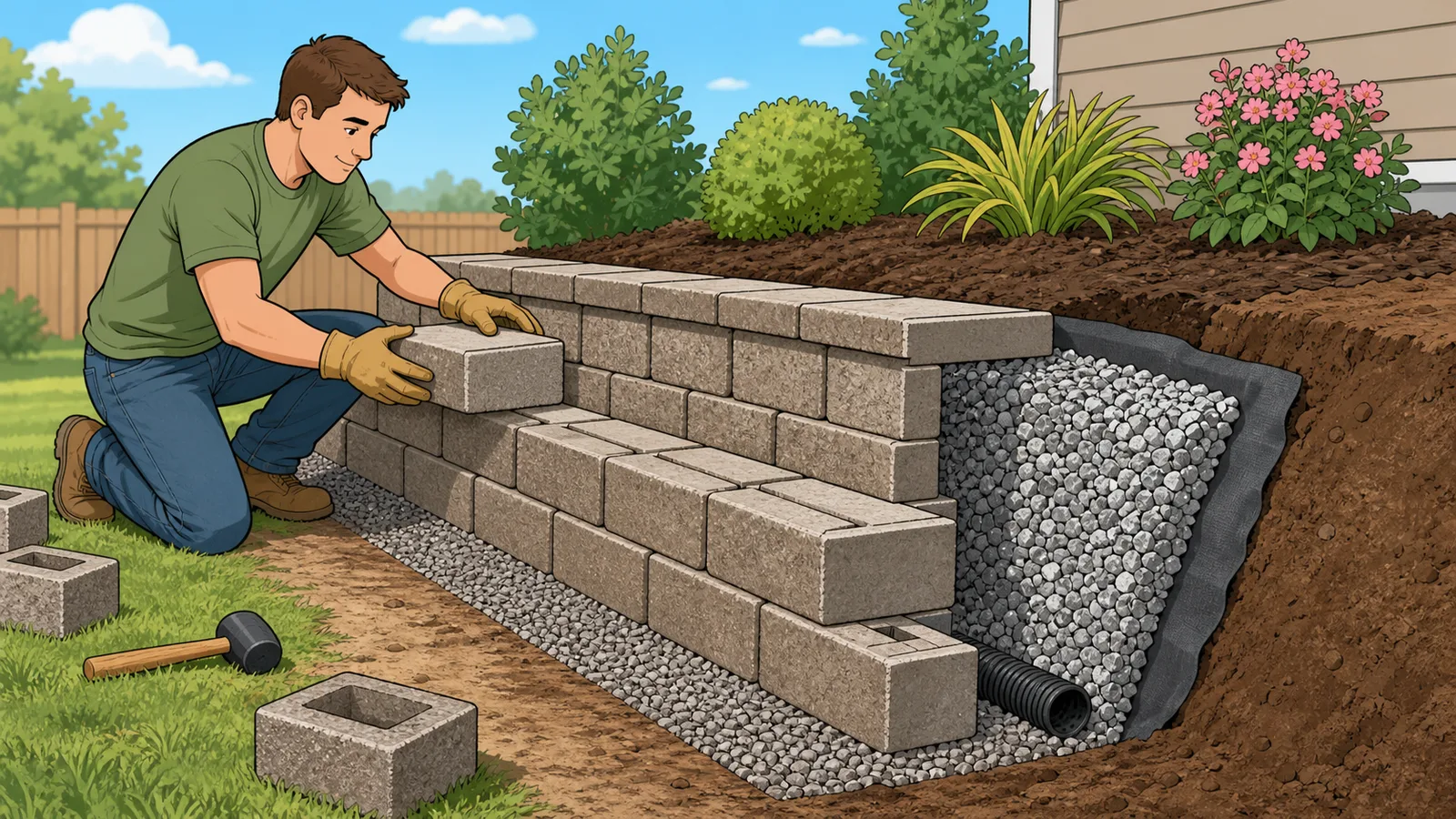
Segmental retaining walls are built from concrete blocks stacked in courses. This retaining wall block calculator divides the wall height by the block face height to estimate rows, divides the wall length by the block face length to estimate blocks per row, and combines those figures into a baseline wall block count.
It also estimates waste blocks, cap units, adhesive tubes, compacted base gravel, drainage stone behind the wall, and optional material cost. That gives you a realistic shopping baseline for a straight wall before you start checking system-specific drainage details, buried base-course depth, corner pieces, curves, or any reinforced design requirements.
Retaining wall formulas used
The core formula is rows = ceiling(wall height ÷ block face height) and blocks per row = ceiling(wall length ÷ block face length). The calculator multiplies those values for the base wall blocks, then applies the waste allowance to produce the order quantity. Cap units are kept separate because the top course is often a different product and price.
Base gravel is estimated from wall length, base trench width, and base gravel depth. Drainage stone is estimated from wall length, exposed wall height, and the drainage stone width behind the wall. These quantities are planning volumes only; the final order can change when the first course is buried, the base steps up a slope, the wall curves, or the block system uses hollow cores that also need clean stone.
Rows = ceiling(wall height ÷ block face height)
Rounds up because partial courses still require whole blocks or field cuts.
Order blocks = ceiling(rows × blocks per row × (1 + waste%))
Adds a practical allowance for cuts, corners, breakage, and spare units.
Models the clean-stone drainage zone behind the wall face.
Why drainage and backfill matter
Retaining walls depend on drainage as much as they depend on the block count. Free-draining aggregate behind the wall helps relieve water pressure, and a correctly prepared base helps keep the first course level so the courses above it stay aligned.
The calculator separates base gravel from drainage stone because those materials answer different questions. Base gravel supports and levels the wall; drainage stone behind the wall helps move water away from the block face. The default drainage-zone width follows the common 12 inch / 300 mm planning assumption visible in many segmental wall installation guides, but manufacturer instructions should control the final detail.
This calculator does not size drainpipe runs, geogrid, buried base depth, footing steps, or any reinforcement details that may be needed once wall height, surcharge, slope, soil, water, fence, driveway, or building loads change.
How to use the result
Use the waste-adjusted wall block count as your order baseline, then confirm the cap count, base material, drainage material, and adhesive against the product you plan to buy. Keep the cap count separate because cap units and adhesive are often priced independently from the main wall blocks.
If you enter unit costs, the calculator gives a simple material-only planning figure for wall blocks, cap units, and gravel. It does not include excavation, drainpipe, geotextile, delivery, labour, engineering, taxes, disposal, or permit costs.
For L-shaped, curved, stepped, or terraced walls, calculate each straight section separately and add the results. Then increase the waste allowance if the layout has many cuts, curves, corners, half-blocks, or special cap transitions.
What this result does not cover
This calculator assumes a straight segmental gravity-style wall with one consistent block size and regular geometry. It does not model setback by course, buried base-course height, hollow-core fill, curves, corners, stairs, geogrid reinforcement, geotextile wrap, drainpipe outlet spacing, or local code triggers for engineering review.
Use it as a first-pass retaining wall material estimate, then confirm the final wall design, drainage detail, allowable height, soil assumptions, and reinforcement requirements against the chosen manufacturer system and any local engineering or permit requirements.
When to get engineering or permit advice
Many simple garden retaining walls are small gravity walls, but height is not the only risk factor. A wall that supports a driveway, patio, building, fence, slope, saturated soil, or poor drainage can need engineering review even when the face height looks modest.
The calculator flags walls around 4 ft tall because that is a common threshold in competitor tools, manufacturer guidance, and local-code discussions. Treat that warning as a prompt to check local rules rather than a universal legal cutoff.
Frequently asked questions
How many blocks do I need for a retaining wall?
Divide the wall height by the block face height to estimate rows, then divide the wall length by the block face length to estimate blocks per row. Multiply those two figures for the base block count, then add a waste allowance for cuts, steps, corners, curves, or damaged units.
How much gravel do I need behind a retaining wall?
That depends on the wall system and drainage detail, but most retaining walls need free-draining aggregate behind the blocks to reduce water pressure. The calculator gives a simple planning quantity only; the final gravel layout should follow the chosen wall system.
Do I need drainage behind a retaining wall?
Yes. Drainage aggregate behind the wall is standard practice because water pressure can build up quickly and push the wall out of alignment. Many systems also use drainpipe and other drainage details, which should be checked against the manufacturer guidance.
How many cap blocks does a retaining wall need?
A straight wall usually needs cap units equal to the number of block positions across the top run, but corners, curves, and special cap shapes can change that total. The calculator gives a straight-wall baseline so you can start pricing the top course.
When does a retaining wall need engineering?
That depends on local code, wall height, the slope above or below the wall, and surcharge loads such as vehicles or fences. Many taller or load-bearing walls need engineered design or permit review even if the material estimate itself looks straightforward.
How much waste should I add for retaining wall blocks?
A straight wall with few cuts may use around 5% to 10% waste, while curves, steps, corners, and mixed block sizes can need more. The calculator lets you set the waste percentage so the order count is more realistic than the bare geometric block count.
Does this calculator include the base gravel under the wall?
Yes. It estimates base gravel from the wall length, base trench width, and base gravel depth. The result is separate from drainage stone because the base layer supports and levels the first course, while drainage stone sits behind the wall.
Can I use this for metric retaining wall blocks?
Yes. Switch the calculator to metric mode to use metres for wall dimensions and millimetres for block, base, and drainage dimensions. The result shows gravel in cubic metres.
Does this estimate geogrid?
No. Geogrid depends on wall height, soil, slope, surcharge, block system, and engineered design tables. Use the calculator for material planning, then check the chosen manufacturer guidance or engineering plans for geogrid length and layer count.