Solve wavelength, frequency, or wave speed from the wave equation v = fλ, with step-by-step interpretation for common wave problems.
Last updated
Wavelength calculator Use this wavelength calculator as a wave equation calculator, frequency to wavelength calculator, and wave speed calculator. Choose which value to solve for in v = fλ, then enter the other two quantities in compatible SI units.
Solve for
The wavelength formula changes depending on the unknown, but the underlying wave equation stays the same. This page keeps the units explicit so you can switch between a wavelength formula, frequency formula, and wave-speed formula without rearranging the algebra by hand.
Formula reference
Wavelength: λ = v ÷ f
Frequency: f = v ÷ λ
Wave speed: v = f × λ
Result
0.69 m
Wavelength calculated from frequency, wavelength, and wave speed using the standard wave equation.
Frequency
500 Hz
Wavelength
0.69 m
Wave speed
343 m/s
Step-by-step wave equation check
Wave equation
v = f × λ
343 = 500 × 0.69
Solve for the unknown
λ = v ÷ f
343 ÷ 500 = 0.69
Calculated result
Wavelength (m)
0.69 m
What this wave equation solver assumes This wavelength calculator uses a direct v = fλ relationship. That works when the entered wave speed is already known or when you are using a standard reference speed such as sound in air or light in vacuum. It does not infer refractive index or medium-specific corrections for you.
Wavelength calculator guide: solve wavelength, frequency
A wavelength calculator helps you rearrange the wave equation when you know any two of wavelength, frequency, and wave speed. This page works as a wavelength formula calculator, a frequency to wavelength calculator, and a wave speed calculator, so you can solve the missing quantity directly from v = fλ.
What a wavelength calculator does
A wavelength calculator solves one missing part of the wave equation when the other two values are known. In physics, the relationship is usually written as wave speed equals frequency multiplied by wavelength.
That same relationship works in three directions. If you know frequency and speed, you can find wavelength. If you know wavelength and speed, you can find frequency. If you know frequency and wavelength, you can calculate wave speed.
The wavelength formula and its rearrangements
The standard wave equation is v = fλ. Here, v is wave speed, f is frequency, and λ is wavelength. Rearranging the same relationship gives λ = v ÷ f and f = v ÷ λ.
Those rearrangements matter because many homework, acoustics, optics, and signal problems start with different known values. A wavelength formula calculator is most useful when it shows all three forms instead of forcing you to rearrange the algebra yourself.
v = f × λ
The core wave equation linking wave speed, frequency, and wavelength.
λ = v ÷ f
Use this form when wave speed and frequency are known and wavelength is the unknown.
f = v ÷ λ
Use this form when wave speed and wavelength are known and frequency is the unknown.
Worked example: sound at 500 Hz moving at 343 m/s
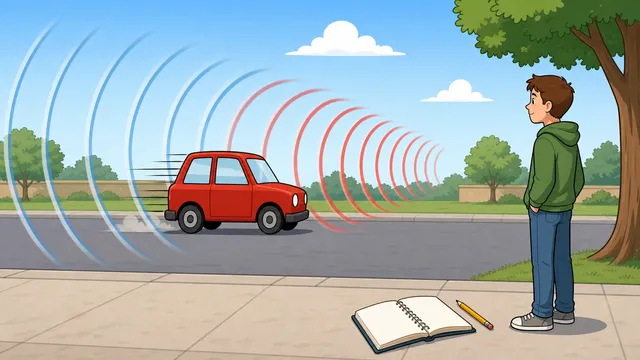
Suppose a sound wave has a frequency of 500 Hz and is traveling at 343 metres per second. The wavelength is 343 ÷ 500, which equals 0.686 metres.
The same example can be checked in reverse. If you start with a wavelength of 0.686 metres and a wave speed of 343 m/s, the frequency comes back to about 500 Hz. That is why a wave equation solver is useful for verification as well as calculation.
Why wavelength changes when frequency changes
For a fixed wave speed, frequency and wavelength move in opposite directions. A higher frequency means more cycles per second, so each cycle must occupy less distance and the wavelength becomes shorter.
A lower frequency means fewer cycles each second, so each cycle can stretch over a longer distance. That is why low-frequency sound waves and radio waves tend to have longer wavelengths than high-frequency ones.
When wave speed is not constant
The simple v = fλ relationship still holds, but wave speed depends on the medium. Sound travels at different speeds in air, water, and steel. Light also behaves differently in vacuum than it does inside glass or fibre.
That means a wavelength calculator is only as accurate as the wave speed you enter. If the problem depends on a specific material or environment, use the appropriate speed for that medium rather than a generic value.
Further reading
Frequency Wavelength Converter — Use the Frequency Wavelength Converter when you want a broader electromagnetic-spectrum conversion sheet.
Wavelength Helper — Use the Wavelength Helper when you want quick medium and unit reference examples for frequency and wavelength.
Frequently asked questions
How do you calculate wavelength?
Divide wave speed by frequency. In the wave equation, wavelength equals v divided by f, as long as both values use compatible units.
How do you calculate frequency from wavelength?
Divide wave speed by wavelength. That is the rearranged form f = v ÷ λ.
How do you calculate wave speed?
Multiply frequency by wavelength. In the wave equation, v = f × λ.
What does v = fλ mean?
It means wave speed equals frequency times wavelength. It is the standard relationship used for sound, light, and many other wave problems.
Why does higher frequency mean shorter wavelength?
If wave speed stays fixed, more cycles per second means each cycle must take up less distance. That makes the wavelength shorter.
Does this wavelength calculator work for sound and light?
Yes, as long as you enter the appropriate wave speed. Sound and light can both be modeled with the same equation, but they use different speeds in different media.
Can I use this as a wave equation solver?
Yes. The page is designed to solve for wavelength, frequency, or wave speed depending on which two inputs you already know.
What units should I use?
Use compatible SI-style units for the cleanest result: metres for wavelength, hertz for frequency, and metres per second for wave speed.
What happens if wave speed changes with the medium?
The equation still works, but the result changes because the speed changes. Use the correct wave speed for air, water, vacuum, glass, or whatever medium your problem describes.
Can wavelength ever be negative?
Not in this type of magnitude-based calculation. Wavelength, frequency, and wave speed should all be treated as positive quantities here.