Calculate buoyant force, displaced volume, or fluid density using Archimedes' principle, then compare object mass, submerged fraction.
Last updated
Buoyancy calculator Solve buoyant force, displaced volume, or fluid density using Archimedes' principle. This page also checks float-or-sink behaviour so searches like buoyant force calculator, Archimedes principle calculator, and float or sink calculator all land on the same physics workflow.
Solve for
Enter displaced volume and fluid density to calculate buoyant force.
Quick examples
Use 9.80665 m/s² for standard Earth gravity, or adjust it for classroom, lab, or off-world examples.
Result
Buoyant force
9.81 N
A displaced volume of 0.001 m³ in a fluid with density 1000 kg/m³ displaces 1 kg of fluid and creates 9.8067 N of buoyant force at standard gravity.
Add an object mass to compare its weight with the neutral-buoyancy threshold and check whether it floats or sinks.
Submerged fraction and ballast margin
Add object mass and total object volume to estimate average density, submerged fraction, and ballast margin.
How to use this result
The displaced fluid mass tells you the exact neutral-buoyancy threshold. If a submerged object weighs less than that threshold, it rises; if it weighs more, it sinks.
Buoyancy calculator: solve buoyant force, displaced volume, or fluid density
Archimedes' principle says a submerged object feels an upward buoyant force equal to the weight of the fluid it displaces: F_b = ρ × V × g. This buoyant force calculator lets you solve buoyant force, displaced volume, or fluid density, then check whether a known object mass would float, sink, or sit at neutral buoyancy.
Archimedes' principle in practice
Buoyancy depends on the displaced fluid, not on the object's material alone. If a body displaces 1 m³ of fresh water with standard gravity, it experiences about 9807 N of upward force because 1000 × 1 × 9.80665 ≈ 9806.65.
Salt water is denser than fresh water, so the same submerged volume produces a slightly larger buoyant force. That is why a ship floats a little higher in a river than in the open sea, and why the same object can feel easier to support in salt water than in a pool.
Worked example: one litre in fresh water
A displaced volume of 1 litre is 0.001 m³. In fresh water at 1000 kg/m³, the buoyant force is F_b = 1000 × 0.001 × 9.80665 ≈ 9.81 N. That is the upward force available before you compare it with the object's own weight.
The displaced fluid mass is also 1 kg, which means the neutral-buoyancy threshold is 1 kg at standard gravity. If the object weighs less than that, it floats; if it weighs more, it sinks.
Float, sink, and neutral buoyancy
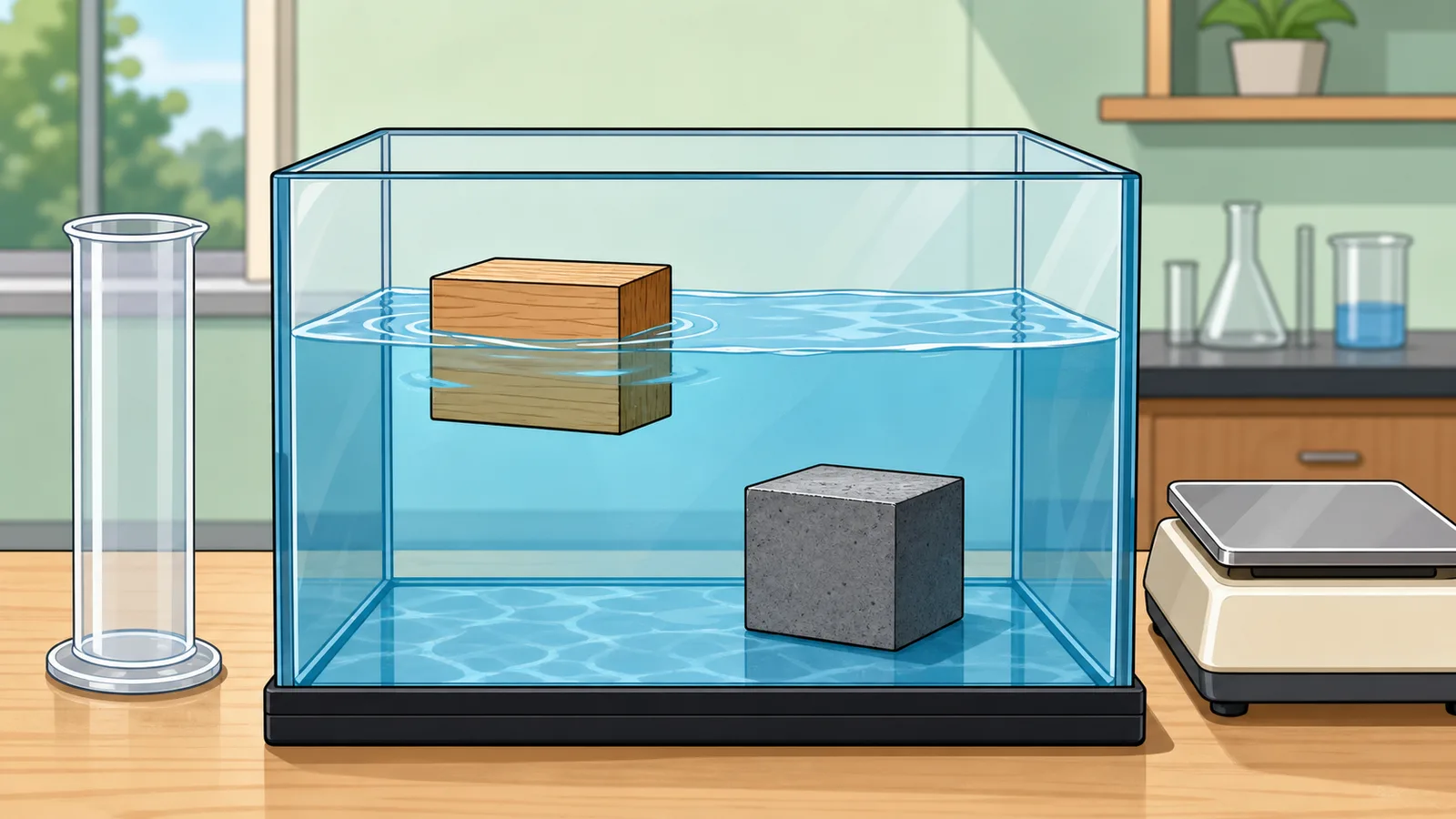
Floating and sinking are just force comparisons. When the buoyant force exceeds the object's weight, the object rises. When the forces are equal, the object is neutrally buoyant. When the object's weight is greater, it sinks.
That threshold is useful in ballast planning, diving, and marine design, where you often want to know how much mass a volume of fluid can support before the system starts to descend.
Submerged fraction and ballast margin
If you know the object's mass and total volume, the calculator can also estimate average object density and the simplified submerged fraction. In a uniform, calm fluid, an object with average density below the fluid density floats with a submerged fraction close to object density divided by fluid density.
The ballast margin is the gap between the object's current mass and the mass of fluid its full volume could displace. A positive margin means extra mass could be added before the object reaches full neutral buoyancy in the simplified model. A negative margin means the object is already too dense to float without more displacement, trapped air, or another buoyant structure.
Solving for force, volume, or fluid density
The calculator can solve any of the three variables in Archimedes' equation: buoyant force, displaced volume, or fluid density. Displaced volume means the submerged portion of the object, not necessarily its full geometric volume.
If you solve for fluid density, the result can be used as a quick sanity check. Fresh water is around 1000 kg/m³, salt water is around 1025 kg/m³, olive oil is around 910 kg/m³, ethanol is around 789 kg/m³, and air at sea level is only about 1.225 kg/m³.
Common reference fluids
The fluid preset buttons cover the density range most people need for planning and educational work. Fresh water, salt water, air, olive oil, ethanol, and mercury show how dramatically buoyant force changes as density rises or falls.
Mercury is especially useful as a reference because its density is far higher than water. A small displaced volume can create a large buoyant force, which is why it appears in classic physics examples even though it is not something you would use casually in the real world.
What can change the answer
Temperature, salinity, and local gravity can all move the result. Liquids usually expand when heated, reducing density a little, while salt content pushes density upward. Gravity is also not perfectly constant across the planet, so very precise work should use a site-specific value.
This calculator treats the fluid as uniform and static. It does not model wave action, tank slosh, compressibility, or the details of a complex hull shape. Those effects matter in real engineering work even when the basic Archimedes calculation is correct.
When the estimate is not enough
Use the result as a planning estimate, not a certification step. For marine design, lifting safety, ballast calculations, or anything where a wrong answer could create a hazard, validate the numbers against the governing standard and a qualified reviewer.
The calculator is still useful for quick comparisons: how much extra buoyancy salt water adds, how much displaced water a prototype needs, or how close a test object is to neutral buoyancy.
Frequently asked questions
What is Archimedes' principle?
Archimedes' principle states that the buoyant force on a submerged object equals the weight of the fluid it displaces. In formula form, F_b = ρ × V × g, where ρ is fluid density, V is displaced volume, and g is gravitational acceleration.
Why do ships float even though steel is denser than water?
A ship floats because its hull displaces a large volume of water and the average density of the whole vessel is below the fluid density. The important number is the density of the entire floating system, not just the density of the steel plates.
What is neutral buoyancy?
Neutral buoyancy happens when the buoyant force exactly matches the object's weight. The object neither sinks nor rises, which is why submarines and divers use ballast systems to control depth.
How do I estimate the fraction of an object that will be submerged?
For a simple floating object in a uniform fluid, divide the object's average density by the fluid density. For example, an object with average density 700 kg/m³ in salt water around 1025 kg/m³ would sit at roughly 68% submerged in the simplified static model.
Does salt water increase buoyancy?
Yes. Salt water is denser than fresh water, so it produces a larger buoyant force for the same displaced volume. That is why the same object usually floats a little higher in salt water than in fresh water.
Can I use this calculator for air buoyancy?
Yes, but the effect is much smaller because air density is tiny compared with liquid densities. Air buoyancy is important in some scientific and aerostatics problems, but everyday float-or-sink searches usually involve liquids.
How does temperature change buoyancy?
Temperature changes fluid density. Warmer liquids usually expand and become slightly less dense, while colder liquids are usually denser. That means buoyant force can shift a little as the temperature changes.
What is displaced volume?
Displaced volume is the amount of fluid pushed aside by the submerged portion of the object. It is the submerged volume, not always the object's total volume.
When should I ask a marine engineer or qualified reviewer?
Whenever the calculation affects lifting safety, ballast control, vessel stability, certification, or any other safety-critical decision. This calculator is good for planning and education, but not as a final sign-off tool.