Compute the vector norm for any real vector, compare L1, L2, L∞, and Lp values, and connect vector magnitude, distance metrics, infinity norm.
Last updated
Vector norm calculator across L1, L2, L∞, and Lp Compute the norm of a vector, compare common norm families side by side, and keep the vector magnitude versus general vector norm distinction clear.
Examples
Use these sample vectors to compare vector norm, L2 norm, and infinity norm behaviour before replacing them with your own components.
Input format Enter components separated by commas, spaces, or new lines. This calculator accepts vectors with any number of components, but it is only for vector norms, not norms of vectors and matrices together.
Norm versus magnitude
In linear algebra, “vector norm” is the broader idea. The familiar vector magnitude is specifically the L2 norm, while L1 and L∞ answer different questions about the same vector.
L2 (Euclidean) norm
5
Parsed 2 components from [3, 4].
This L2 result is also the vector magnitude.
Components
2
Max |xi|
4
Selected norm
L2 (Euclidean)
Norm interpretation
Context
Value
How to read it
Selected norm meaning
L2 (Euclidean)
This is the Euclidean length, so it is also the vector magnitude.
Vector magnitude link
5
The L2 norm is the same quantity the vector magnitude page calls length or magnitude.
Distance interpretation
Euclidean distance
A norm can measure distance between two points by applying it to the difference vector.
Norm ordering for this vector
7 ≥ 5 ≥ 4
For any real vector, L1 is at least as large as L2, which is at least as large as L∞.
Vector-only scope
No matrix norms
This page is for vector norms only, not induced norms of a matrix or matrix/operator norm comparisons.
Vector norm calculator: compare L1, L2, L∞, and Lp norms
A vector norm calculator measures vector size in more than one way. This page also explains the main assumptions behind the vector norm calculator result, highlights the supporting figures shown by the calculator, and helps the reader use the estimate without overstating what a quick online tool can prove.
What the common vector norms are measuring
The L1 norm adds absolute component sizes, so it tells you the total absolute movement across coordinates. The L2 norm is the Euclidean length you get from the Pythagorean theorem. The L∞ norm ignores everything except the largest absolute component, which is why it is sometimes used in worst-case bounds.
The general Lp norm is (Σ|vᵢ|^p)^(1/p). L1 and L2 are just the familiar special cases p = 1 and p = 2, while larger p values place more weight on the biggest components. In the limit, the p-norm approaches the infinity norm.
||x||ₚ = (Σ |xᵢ|ᵖ)^(1/p), p ≥ 1
General p-norm definition for vectors. This is the specific relationship the calculator applies when building the result.
||x||∞ = maxᵢ |xᵢ|
Infinity norm definition. This is the specific relationship the calculator applies when building the result.
Why the chosen norm changes the answer
For the vector (3, 4), the L1 norm is 7, the L2 norm is 5, and the L∞ norm is 4. None of those answers is more universally correct than the others; they answer different questions about the same vector.
That is why a good vector norm calculator should not stop at one output. Comparing the norms side by side helps you decide whether you care about total absolute size, Euclidean length, or the single largest component.
It also helps explain why a vector magnitude calculator is only one special case. Vector magnitude is the L2 norm, but the broader phrase vector norm includes L1, L∞, and general Lp norms as well.
Vector norm versus vector magnitude
Students often meet the L2 norm first, so they naturally treat norm and magnitude as interchangeable. In ordinary Euclidean coordinates, that is fine when you specifically mean the 2-norm. But a norm of a vector does not have to be Euclidean length.
The broader idea is that a norm measures vector size while satisfying the norm rules. The L2 norm gives the familiar straight-line length, the L1 norm sums absolute component sizes, and the infinity norm keeps only the largest absolute component. That is why this page compares them instead of hiding the alternatives.
Infinity norm and worst-coordinate size
The infinity norm of a vector is the largest absolute component. It is useful when the biggest coordinate sets the tolerance, the error bound, or the worst-case size you care about.
For example, if x = (2, -5, 3), then ||x||∞ = 5. Even though the L1 and L2 norms use all components, the infinity norm answers the narrower question: what is the single largest coordinate magnitude in this vector?
Using a vector norm as a distance measure
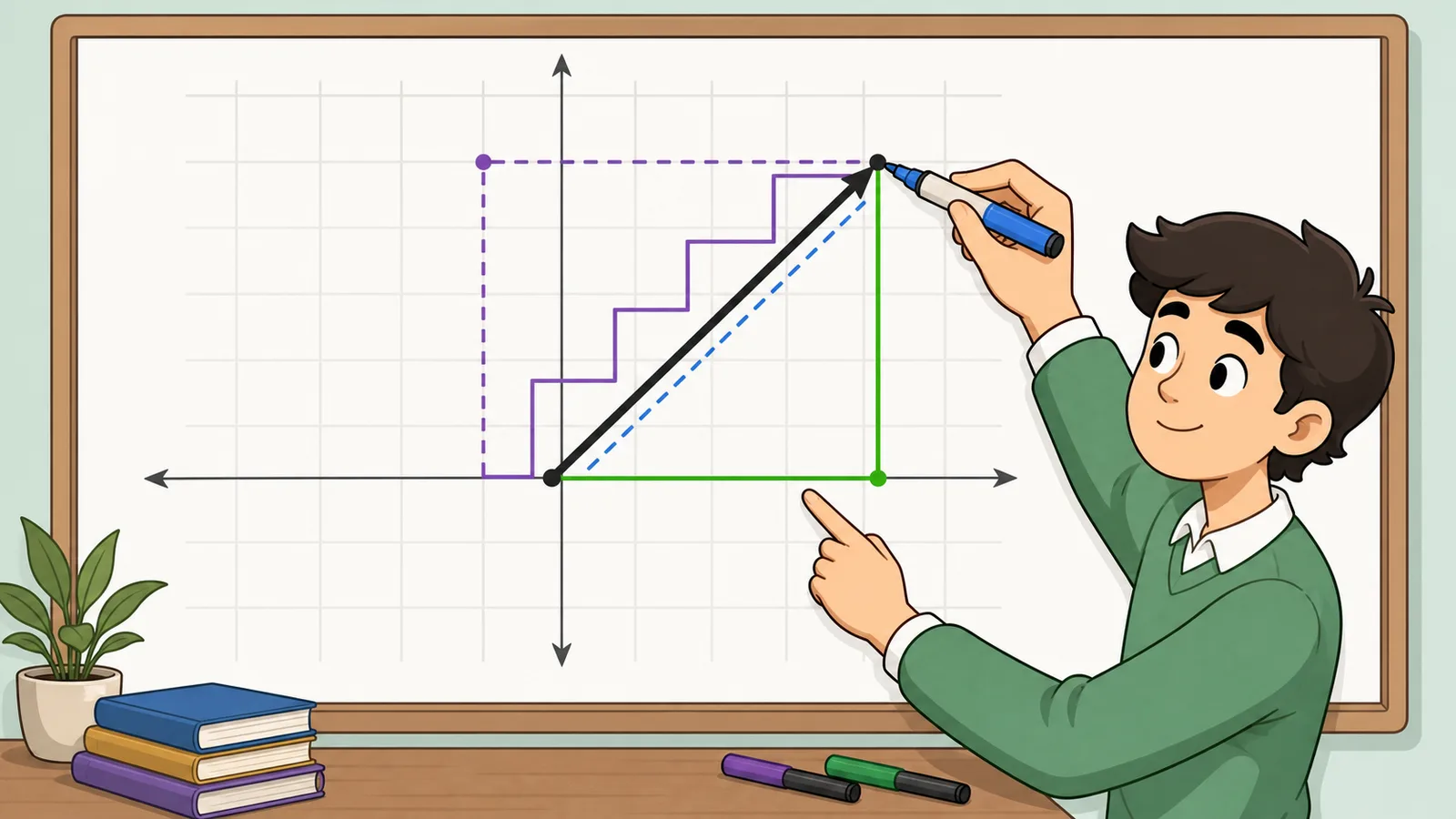
A vector norm can also become a distance rule. To measure the distance between two points or vectors, subtract them first, then take the norm of the difference vector. That is why L1 is linked with Manhattan distance, L2 with Euclidean distance, and L∞ with Chebyshev distance.
This distinction matters in optimisation, numerical analysis, machine learning, and geometry problems. The calculator evaluates one vector directly, but the same formulas apply after you convert a two-point distance question into a difference vector.
How this differs from software norm commands
Software tools often use one command name for several related calculations. In MATLAB, NumPy, and Wolfram Language documentation, a norm command may handle vectors, matrices, Frobenius norms, operator norms, complex values, and special cases such as infinity norms.
This page intentionally keeps the scope narrower. It calculates real vector norms only, which makes the output easier to read for coursework, quick checking, and comparing L1, L2, L∞, and Lp behaviour without mixing in matrix-norm conventions.
Worked example: vector (1, -2, 2)
Take x = (1, -2, 2). The L1 norm is |1| + |−2| + |2| = 5. The L2 norm is √(1² + (−2)² + 2²) = √9 = 3. The L∞ norm is max(1, 2, 2) = 2.
If you choose p = 3, the calculator instead uses (|1|³ + |−2|³ + |2|³)^(1/3) = (1 + 8 + 8)^(1/3) = 17^(1/3), which is about 2.57. That falls between the infinity norm and the L2 norm, which is exactly the kind of behaviour users often want to inspect.
What this calculator accepts and what it rejects
You can enter components separated by commas, spaces, or line breaks, and the page will parse them into one vector. Every component must be a finite real number, and the vector must contain at least one component.
For Lp, this calculator requires p ≥ 1. Values with 0 < p < 1 are sometimes discussed in optimisation or sparse modelling, but they do not satisfy the triangle inequality, so they are not true norms. This page treats them as invalid instead of quietly labelling them as norms.
What this tool does not do
This calculator focuses on vector norms only. It does not test all norm axioms symbolically, compare matrix norms, or prove equivalence bounds between norms in finite-dimensional spaces. That means topics such as norms of vectors and matrices together, or the induced norm of a matrix, belong on a different page.
It also does not support complex-valued vectors, weighted norms, or custom inner products. If you need those extensions, use this page as a quick real-vector reference rather than a complete functional-analysis tool.
Frequently asked questions
What is a vector norm in plain language?
A vector norm is a rule for measuring the size of a vector. Different norms measure size differently, which is why the same vector can have one L1 norm, another L2 norm, and a different infinity norm.
Which vector norm should I use?
Use L2 when you want ordinary Euclidean length, L1 when you care about total absolute component size, and L∞ when the largest component controls the problem. If you are tuning an Lp norm, remember that larger p values put relatively more emphasis on the biggest coordinates.
Is vector magnitude the same as vector norm?
Vector magnitude is specifically the L2 norm. It is one important vector norm, but not the only one. L1, L∞, and general Lp norms measure vector size in different ways.
Why does the L1 norm come out larger than the L2 norm for the same vector?
Because they measure size differently. L1 adds all absolute components directly, while L2 first squares them and then takes a square root. For most non-zero vectors with more than one active component, the L1 norm will be at least as large as the L2 norm.
Is the L2 norm the same as vector magnitude?
Yes. In ordinary Euclidean coordinates, the L2 norm is the standard vector magnitude or length. That is why many vector tools treat “magnitude” and “Euclidean norm” as the same quantity.
What is the infinity norm of a vector?
The infinity norm is the largest absolute component in the vector. It is often used for worst-case bounds because it ignores every coordinate except the biggest one.
Can a vector norm calculator find distance between two vectors?
Yes, if you first subtract the vectors. The norm itself measures one vector, so the distance from u to v is found by calculating the norm of u − v. With L1 this becomes Manhattan distance, with L2 it becomes Euclidean distance, and with L∞ it becomes Chebyshev distance.
Why do software norm commands mention matrices when I only need a vector norm?
Many software libraries use one norm command for both vectors and matrices. The formulas are not always the same across those cases. This calculator keeps the scope to real vector norms so the L1, L2, infinity norm, and selected p-norm outputs stay directly comparable.
Can I use p = 0.5 in an Lp norm calculator?
You can compute the expression numerically, but it is not a true norm when p is below 1 because it fails the triangle inequality. This calculator rejects p values below 1 so it stays mathematically honest about what counts as a norm.
Does this page calculate matrix norms too?
No. This page is for vector norms only. Matrix norms, Frobenius norms, and induced norms of a matrix use different definitions and need their own handling.