How many litres is a standard household water tank?
Domestic storage tanks vary widely by country, installation type, and whether the quoted size is nominal or usable capacity. Smaller loft or utility tanks may be in the low hundreds of litres, while rainwater and outdoor storage tanks can be much larger. Measure the internal length, width, height, diameter, or liquid depth for the specific tank instead of relying on a generic label.
Does the tank wall thickness affect the volume?
Yes. This calculator uses the dimensions you enter as the internal volume dimensions. If you measure external dimensions, subtract twice the wall thickness from each relevant measurement before entering the values. The adjustment matters most for small tanks, thick-walled tanks, and cylindrical tanks because diameter is squared in the volume formula.
How do I convert litres to US gallons?
One US gallon equals approximately 3.785 litres. To convert litres to US gallons, divide litres by 3.785. One UK imperial gallon is larger at approximately 4.546 litres, so the calculator shows US gallons and UK gallons separately.
How do I calculate the volume of a rectangular tank?
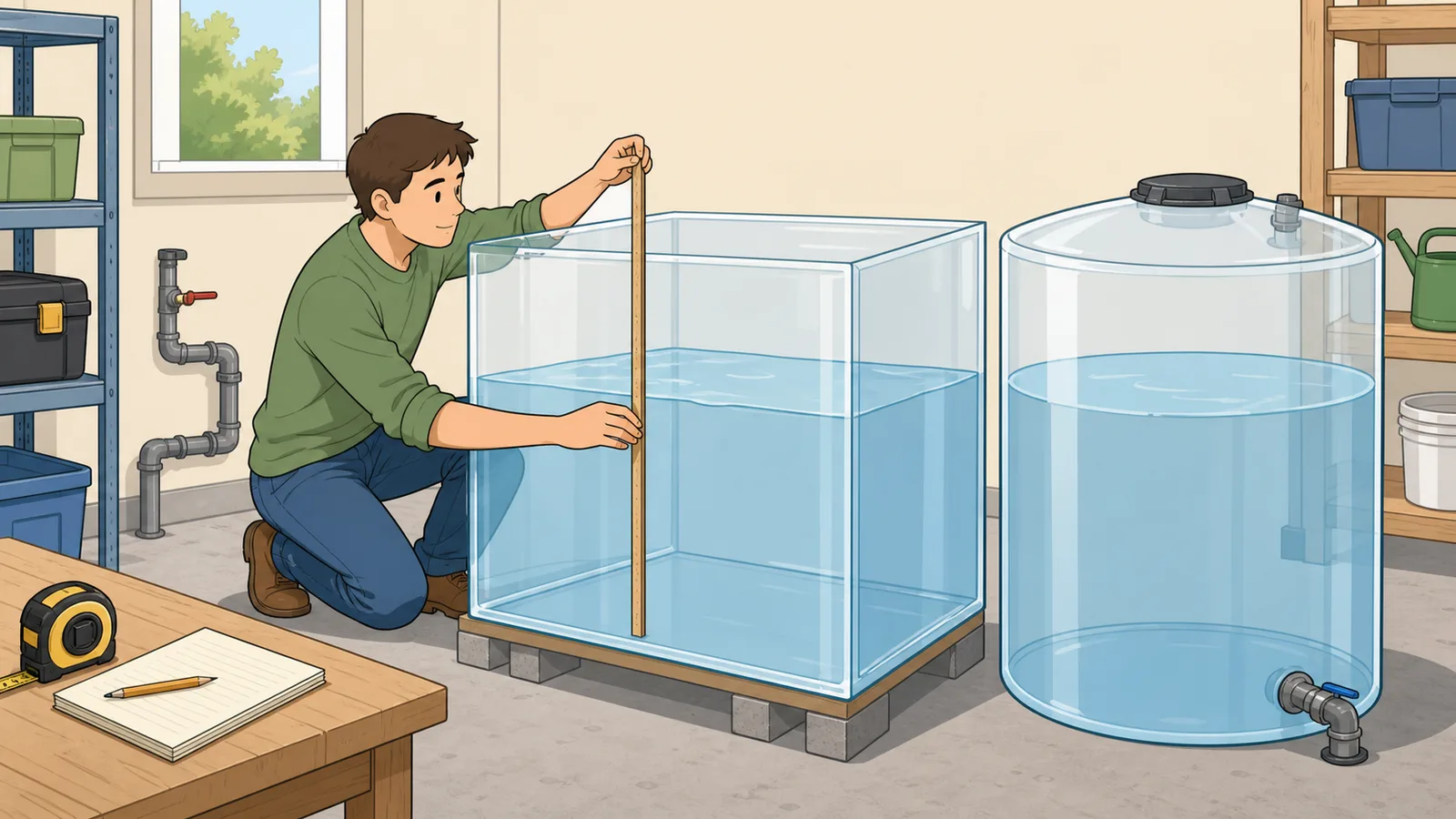
Multiply internal length by internal width by internal height. If the measurements are in centimetres, the result is cubic centimetres, and dividing by 1,000 gives litres. If you only need the current filled volume, replace the full tank height with the current liquid depth.
How do I calculate the volume of a cylindrical tank?
For a full cylinder, multiply π by radius squared and then by the cylinder height or length. Radius is half the diameter. For a vertical cylinder with a partial fill, replace the full height with the current liquid depth. For a horizontal cylinder, use the circular-segment formula because liquid depth is not proportional to volume.
Why is a horizontal tank not half full at half the diameter?
At exactly half the diameter, a horizontal cylinder is half full. The non-linear issue appears away from the midpoint: one quarter of the diameter is much less than one quarter of the volume, while three quarters of the diameter is much more than three quarters of the volume. The curved cross-section means each additional centimetre or inch of depth adds a different amount of liquid.
What is ullage in a tank?
Ullage is the empty space remaining above the liquid. In practical terms it is the difference between total tank capacity and current filled volume. It helps answer questions such as how much more water can fit, whether a fuel delivery will overflow, or how much reserve capacity remains before a rainwater tank is full.
Can I use this as an aquarium volume calculator?
Yes, for rectangular, cylindrical, oval, or L-shaped aquariums where the geometry is close to one of the supported shapes. For aquariums, remember that real water volume is lower than geometric capacity once substrate, rock, wood, filters, and equipment displace water. Dose aquarium treatments from the best estimate of actual water volume, not from the tank's marketing size.
Can I use this for fuel, oil, or chemical tanks?
You can use it for planning and approximate inventory when the tank shape matches the supported geometry and you know the internal dimensions. For regulated fuel storage, custody transfer, safety-critical chemical storage, or environmental reporting, use the tank manufacturer's chart, certified strapping table, or qualified engineering guidance.
What density should I enter for liquid weight?
Use 1.00 kg/L for fresh water, about 1.025 kg/L for seawater, and a product-specific density for other liquids. Many fuels and oils are lighter than water, while brines and some process liquids are heavier. The calculator multiplies filled litres by density to estimate liquid weight.
Why does my measured fill not match the labelled tank size?
Labelled sizes are often nominal. Real usable volume can differ because of wall thickness, rounded corners, internal baffles, fittings, a raised outlet, displacement from contents, manufacturing tolerance, or a required air gap at the top. Measuring internal dimensions and current liquid depth gives a better planning estimate than relying on the label alone.
Does this calculator work for tanks with domed or dished ends?
Not exactly. The horizontal-cylinder option assumes a straight cylindrical shell with flat ends, and the oval option assumes a simple elliptical end profile. Dished pressure-vessel heads, hemispherical ends, conical bottoms, and irregular tanks need specialist formulas or manufacturer charts.