Convert rise over run to degrees with percent grade, radians, decimal slope, 1:N ratio, roof-pitch notation, slope length, and practical reference slopes.
Last updated
Rise-over-run to degrees Convert a vertical rise and horizontal run into slope angle, percent grade, radians, decimal slope, roof-pitch notation, and a normalized 1:N ratio.
Common presets
Reading the ratio
A 1:12 slope means one unit of rise for every 12 units of horizontal run. Lower N values mean a steeper angle.
Angle relationship
The angle comes from arctan(rise ÷ run). Percent grade uses the same ratio, multiplied by 100.
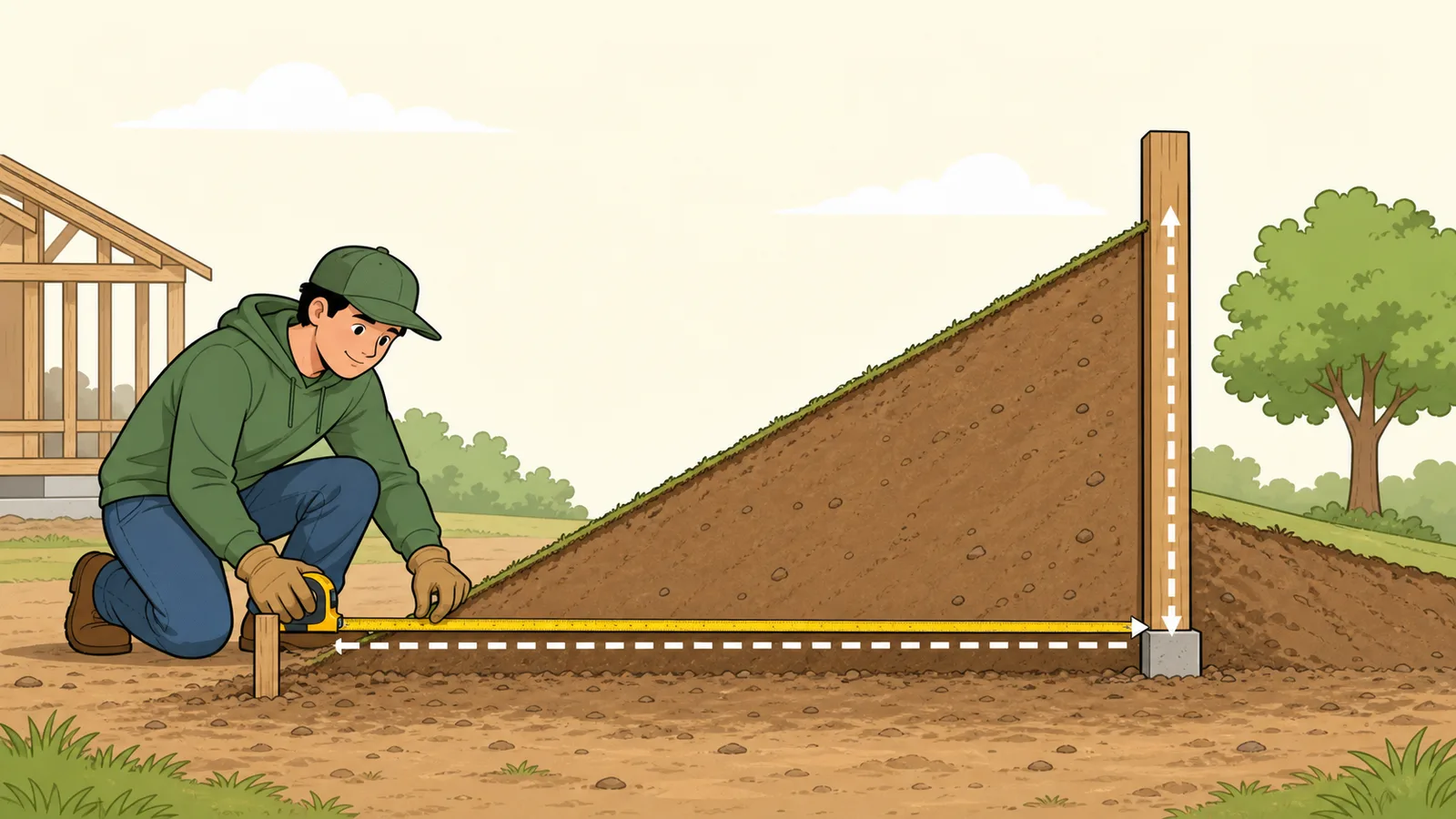
Measure horizontal run
Use the flat horizontal distance, not the sloped surface length. The calculator also shows the sloped length so you can spot that difference.
Result
4.7636°
A ratio of 1 : 12 is ascending at 8.3333% grade, or about 1 : 12 when normalized to one unit of rise. The closest built-in reference is 1:12 ramp.
Degrees
4.7636°
Radians
0.0831 rad
Percent grade
8.3333%
1:N equivalent
1 : 12
Decimal slope
0.0833
Roof pitch
1:12
Slope length
12.0416
Pitch multiplier
1.0035
Interpretation
Ascending slope. Every 12 units of horizontal run changes elevation by 1 units, with a sloped surface length of 12.0416 in the same units.
Formula check
rise ÷ run = 0.0833; arctan(0.0833) = 4.7636°. The same ratio is 8.3333% grade.
Roof-pitch reading
Normalized to a 12-unit run, this is 1:12. The pitch multiplier is 1.0035, so a sloped surface is about 0.3466% longer than the horizontal run.
Edge case
A zero run is vertical, which pushes the angle to ±90° and percent grade to an infinite value.
Rise-over-run to degrees calculator: slope angle, percent grade, and 1:N ratios explained
A rise-over-run to degrees calculator turns a simple geometry ratio into the angle and grade terms people actually use in ramps, roofs, grading, and accessibility work. Enter the vertical rise and horizontal run to see the matching slope angle, percent grade, radian value, and normalized 1:N format.
How rise and run become an angle
Rise-over-run is the tangent relationship of a slope triangle. Once you divide rise by run, the angle from horizontal comes from the inverse tangent function and the percent grade comes from the same ratio multiplied by 100.
That means one input pair gives several valid descriptions of the same incline. A 1:12 slope is about 4.76 degrees and 8.33 percent grade.
Angle = arctan(rise / run)
Converts the geometric ratio into degrees or radians.
Percent grade = (rise / run) × 100
Reports the same slope as a percentage of horizontal run.
1:12 = 8.33% ≈ 4.76°
Common accessibility and sitework reference point.
Why the horizontal run matters
Rise-over-run always uses horizontal distance, not the sloped path length along the surface. If you use the sloped length instead of the horizontal run, the resulting angle and percent grade will be understated.
That is one reason field slope checks can disagree if the measuring method changes. The ratio only means what you think it means when rise and horizontal run were measured consistently.
The calculator keeps the horizontal-run calculation first, then shows slope length separately. That helps when a drawing, map, roof, or ramp measurement gives you a sloped surface length and you need to avoid mixing it with the run.
What the extra outputs mean
Degrees are usually the easiest output to visualize, but slope work often moves between several notations. Percent grade is common for roads, drainage, ramps, and terrain. A 1:N ratio is common when a standard or specification describes a slope such as 1:20 or 1:12. Roof pitch is commonly written as rise per 12 units of horizontal run.
For the same rise and run, the calculator also shows decimal slope, sloped length, and pitch multiplier. Decimal slope is rise divided by run. Sloped length is the hypotenuse of the right triangle. Pitch multiplier is sloped length divided by horizontal run, which is useful when a surface is longer than its flat projection.
Decimal slope = rise / run
The shared ratio behind angle, percent grade, and 1:N notation.
Slope length = √(rise² + run²)
The distance along the inclined surface when rise and horizontal run are known.
Roof pitch = (rise / run) × 12
Normalizes any rise-over-run pair into X:12 pitch notation.
Reference slopes to compare against
A bare angle is easy to misread, so the result includes common comparison rows. For example, a 2 percent grade is only about 1.15 degrees, a 1:20 slope is about 2.86 degrees, a 1:12 ramp is about 4.76 degrees, and a 4:12 roof pitch is about 18.43 degrees.
These references are not design approvals. They are orientation points that make it easier to see whether an entered slope is closer to gentle drainage, a walking slope, a ramp-like incline, a roof pitch, or a very steep 45-degree grade.
How to convert rise over run to degrees by hand
First confirm that rise and run use the same length unit. Then divide rise by run to get the decimal slope. Finally, take the inverse tangent of that decimal and express the result in degrees. If your calculator is set to radians, multiply the radian answer by 180 divided by pi.
For a 4:12 roof pitch, rise divided by run is 4 divided by 12, or about 0.3333. The inverse tangent of 0.3333 is about 18.43 degrees. For a 1:12 ramp, the decimal is 0.0833 and the angle is about 4.76 degrees.
Common use cases and caution points
A focused rise-over-run calculator is handy when you already know the vertical and horizontal distances from a drawing, site measurement, framing detail, or ramp layout and want the angle without doing trigonometry manually.
It should not be treated as a standalone compliance decision. Accessibility rules and field measurements may distinguish running slope, cross slope, tolerances, and location-specific standards.
For practical work, record the source of the numbers you enter. A map distance, roof framing measurement, ramp plan dimension, and tape measurement along a slope can describe different legs of the triangle.
What is the difference between rise-over-run and percent grade?
Rise-over-run is the raw geometric ratio. Percent grade is that same ratio multiplied by 100, so a slope of 1 over 12 becomes about 8.33 percent.
Can a negative rise produce a negative angle?
Yes. A negative rise with a positive run represents a descending slope, so the angle and percent grade become negative.
Why is a zero run treated as vertical?
Because the surface rises without any horizontal distance. That pushes the angle to ±90 degrees and makes percent grade effectively infinite.
Is 1:12 the same as 12 percent?
No. A 1:12 ratio means one unit of rise for every 12 units of run, which is about 8.33 percent grade, not 12 percent.
How do I convert rise over run to degrees by hand?
Divide the rise by the horizontal run to get the slope ratio, then take the inverse tangent of that ratio. The calculator does the same trigonometric step for you and also shows the matching percent grade and 1:N form.
What is the difference between degrees and percent grade?
Degrees measure the angle of the slope, while percent grade measures rise as a percentage of horizontal run. They describe the same incline in different units, so one number can be converted into the other if you know the underlying rise-over-run ratio.
What is the formula for rise over run to degrees?
Use angle = arctan(rise / run). The rise and horizontal run must use the same unit, and the inverse tangent result should be converted to degrees if your calculator returns radians.
How many degrees is a 4:12 roof pitch?
A 4:12 roof pitch has a decimal slope of 4 / 12, or about 0.3333. The inverse tangent of 0.3333 is about 18.43 degrees, and the pitch multiplier is about 1.054.
What is a 2 percent grade in degrees?
A 2 percent grade means rise divided by horizontal run equals 0.02. The inverse tangent of 0.02 is about 1.15 degrees.
Should I enter sloped length as the run?
No. Run is the horizontal distance. If you enter the sloped surface length as run, the calculated angle and percent grade will be too low because the calculator will be using the wrong side of the triangle.
What does pitch per 12 mean?
Pitch per 12 rewrites the same rise-over-run ratio as rise per 12 units of horizontal run. A 1:12 slope is 1:12 pitch, while a 4-inch rise over 12 inches of run is a 4:12 roof pitch.