Use this baking pan converter to scale recipes for round, square, and rectangular pans by area or volume, with ingredient-adjustment and unscaled-depth checks.
Last updated
Baking pan converter and recipe scaling calculator Compare the original and target pan by area or by full pan volume, then scale batter, brownies, bars, casseroles, or frosting with less guesswork before you bake.
Common pan swaps
Pan shape
Scaling basis
Measurement tip
Measure the usable inside baking surface, not the outer rim of the pan. Sloped sides, heavy rounded corners, and decorative specialty pans can change the true capacity.
Area versus volume
Use area scaling when the batter depth will stay roughly the same in the new pan. Use volume scaling when both the footprint and the filling depth change materially between pans.
Result
1.2656x
The target pan needs about 26.5625% more mixture than the original when compared by surface area.
Original area
50.2655 in²
Target area
63.6173 in²
Percent change
+26.5625%
Multiply recipe by
1.2656x
Original recipe in target pan
20.9877% thinner
Keep the original recipe as written? If you keep the original recipe quantity, the batter will sit about 20.9877% thinner in the target pan.
Baking note
Scaling ingredient quantity does not guarantee identical bake time. Deeper batters often need longer in the oven, while wider or shallower pans may bake faster and brown sooner.
For rising batters, avoid filling the target pan much past about two thirds full. If the unscaled or scaled result still looks tight, divide the mixture between pans instead of forcing one overfilled bake.
Baking pan converter and recipe scaling: compare area, volume, and ingredient adjustments
A baking pan converter or pan size and recipe scaling calculator helps when you need to move a recipe from one pan to another without guessing. By comparing the original and target pan by surface area, or by full pan volume when the depth changes too, the tool estimates how much more or less mixture the new pan can hold and what happens if you keep the original recipe quantity unchanged.
Why pan size changes recipe quantity
A recipe written for one pan shape and size assumes a certain batter footprint and usually a certain depth. If you switch to a wider pan, the batter spreads thinner. If you switch to a smaller or deeper pan, the mixture sits thicker and the same quantity may overfill the pan.
That is why recipe scaling starts with geometry. Round pans scale from circle area, rectangular pans scale from width multiplied by length, and a full volume comparison multiplies that footprint by batter depth when the depth changes too.
Round area = π × r²
Used for circular cake tins and springform pans.
Rectangular area = Width × Length
Used for trays, roasting tins, and sheet-style pans.
Scaling factor = Target area or volume ÷ Original area or volume
The multiplier applied to the ingredient list when comparing the two pans.
When to use area scaling versus volume scaling
Use area scaling when the new pan will hold the batter at roughly the same depth. This is common when moving between similar round tins or between two pans of the same style. Use volume scaling when both the footprint and the intended depth change, because then the height of the batter matters too.
The calculator does not pretend that baking time scales perfectly with quantity. A deeper pan often needs more time, while a shallower pan may brown sooner even if the ingredient ratio is correct.
How to use the result in practice
Start by applying the scaling factor to the batter, filling, or frosting quantities. Then treat the bake time as a separate judgment call: deeper batters usually need more time, while broader and thinner bakes should be checked earlier.
The optional example ingredient field is there to help you sense-check the multiplier before you rewrite the full recipe. It is a planning aid, not a substitute for normal baking judgment on doneness and oven performance.
Can you keep the original recipe without scaling it?
That is often the real question behind a recipe pan conversion calculator. If the target pan is larger, the original batter quantity will sit thinner and may bake faster or look flatter than the recipe intended. If the target pan is smaller, the same unscaled recipe will sit deeper and may need more time, or it may overfill the pan outright.
That is why the calculator now reports what the original recipe would do in the new pan before you scale anything. For brownies, bars, casseroles, and tray bakes, that quick thicker-versus-thinner check can be more useful than the raw multiplier alone.
Round, square, and rectangular pan swaps
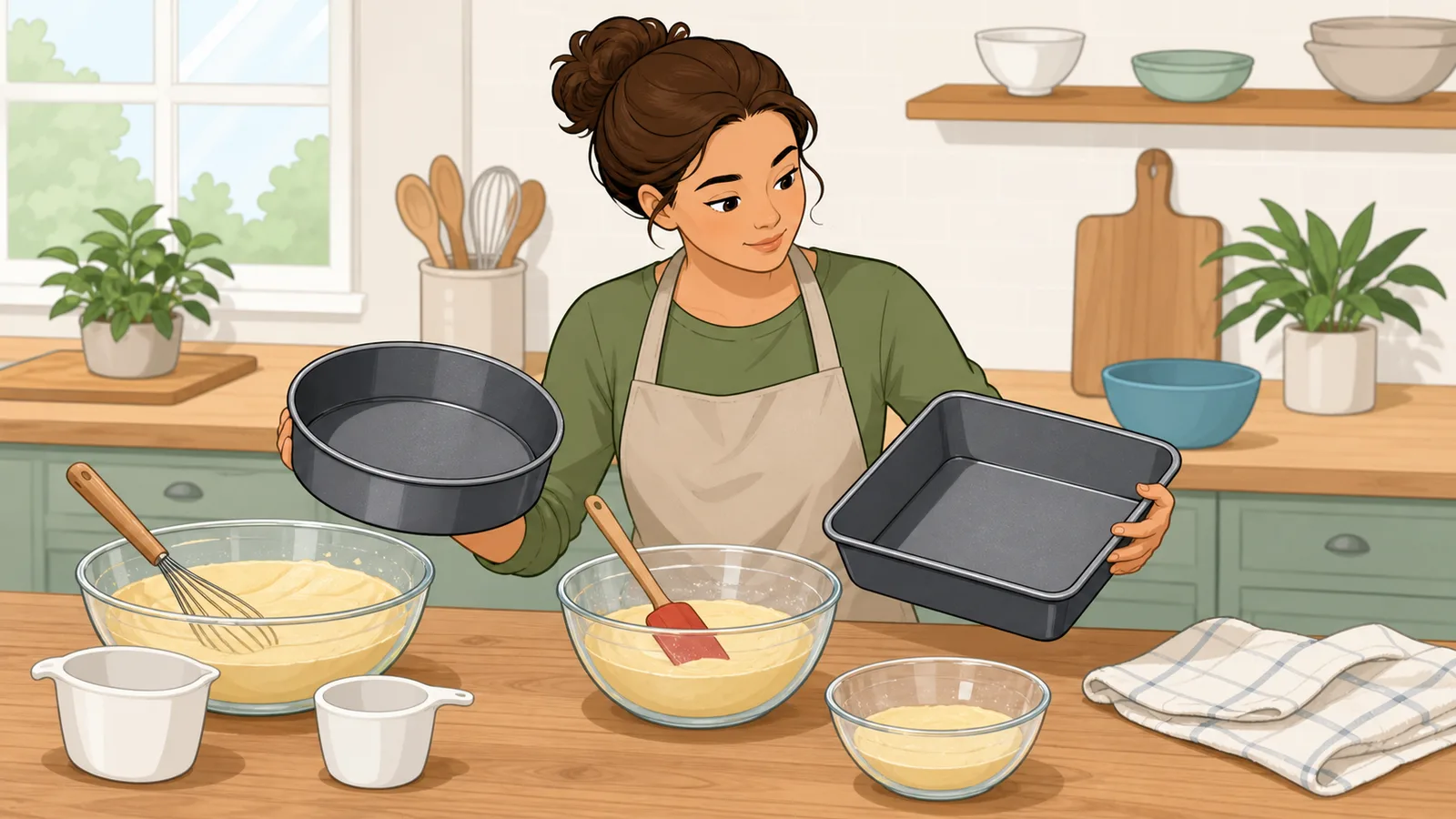
A round tin, an 8x8 square pan, and a 9x13 rectangular pan are not interchangeable just because they sound close in size. A square pan often holds more mixture than a round pan with a similar headline dimension, while a wide rectangular tray can spread the same recipe much thinner.
That is why searchers often want answers like "8x8 to 9x13 pan conversion" or "round to square pan conversion" rather than a generic recipe multiplier. Pan geometry changes the layer thickness, the likelihood of overflow, and the first doneness check timing.
Fill level, depth, and the two-thirds rule
Even a strong baking pan converter should not stop at surface area. If the batter is a rising cake, quick bread, or casserole with a lot of expansion, you still need practical fill-level judgment. A useful kitchen rule is to avoid filling the pan much past about two thirds full unless the recipe is designed for a taller rise.
That matters most when you move into a smaller pan, a deeper dish, or a pan with curved corners and sloped sides. If the scaled or unscaled result looks too full, split the batch between pans instead of forcing one risky bake.
Frequently asked questions
Can I just multiply all ingredients by the scaling factor?
Usually that is the correct starting point for batter, filling, or frosting quantities, but baking time and doneness still need separate judgment because pan depth and oven behaviour change how the recipe cooks.
Why does a deeper pan need special care even if the factor is correct?
Because the centre of a deeper batter takes longer to set. The quantity may be right, but the bake can still need a longer time or a slightly different temperature strategy to avoid over-browning the edges.
When should I use volume instead of area?
Use volume when the batter depth changes materially between pans. If the depth is staying roughly the same, area is usually the more appropriate basis.
Does this work for round and rectangular pans equally?
Yes, as long as you choose the correct shape and measure the actual inside baking dimensions. The geometry changes, but the scaling principle is the same.
Is this a baking pan converter or a cake pan converter?
This page is the broader baking pan converter. It is useful for cakes, brownies, bars, casseroles, and other tray-style bakes where pan footprint and depth affect the result. Cake-specific swaps can overlap, but this page is designed for the more general pan size scaling workflow.
Can I use an 8x8 pan instead of a 9x13 pan?
Yes, but not with the same quantity. An 8x8 pan has much less area than a 9x13 pan, so the original recipe would sit much deeper and may overflow or bake more slowly. Use the scaling factor to shrink the batch or be prepared for a taller bake.
How do I scale eggs when the multiplier is awkward?
For baking, crack the eggs into a bowl, beat them lightly, and use the scaled proportion by weight or by partial volume. That is more accurate than trying to estimate fractions of an intact egg by eye.
Should I measure the inside or outside of the pan?
Measure the usable inside baking surface. Outside dimensions, heavy rolled rims, and sloped walls can make the pan look larger than the actual batter footprint.
Does pan material change the result even if the size is correct?
Yes. Dark metal, glass, ceramic, and light metal pans can brown and hold heat differently. The scaling math helps with quantity, but material still affects baking time and edge color.
When does volume mode matter more than area mode?
Volume mode matters when the new pan is meaningfully deeper or shallower than the original and you want the full depth change to count. It is especially useful for taller cakes, deeper casseroles, and other bakes where capacity changes beyond the footprint alone.