Use this joist span calculator to look up AWC DCA 6 deck joist spans, allowable overhang, and planned clear-span margin by species, joist size, and spacing.
Last updated
U.S. deck joist span reference Look up the prescriptive maximum joist span and allowable overhang from the AWC residential deck guide, then compare a planned clear span before you set beam lines.
Scope
This version is a U.S. residential deck-joist lookup based on AWC DCA 6 Table 2, not a general floor-joist, ceiling-joist, or engineered framing design tool.
Maximum joist span
14' - 0"
2x10 joists in Southern Pine No. 2 at 16" on center span up to 14' - 0" with an allowable overhang up to 3' - 5" under the AWC deck-guide assumptions.
Your planned 14' - 0" clear span is 0" inside this table limit.
Allowable overhang
3' - 5"
Usable overhang for this span
3' - 5"
Planned span check
Fits
Planned clear span
14' - 0"
Span margin
0"
Source table
AWC DCA 6 Table 2
Spacing
16" o.c.
Decimal span
14.00 ft
Planned span fits this table row The entered clear span is inside the AWC DCA 6 row for the selected species group, joist size, and spacing. Keep checking beam, footing, connection, and local-code requirements before building.Actual overhang check For your planned 14' - 0" main span, the published overhang value of 3' - 5" still fits within the one-quarter-of-span rule.
Joist size
Max span
Allowable overhang
Planned span fit
2x6
9' - 0"
1' - 1"
Too short (-5' - 0")
2x8
11' - 10"
2' - 0"
Too short (-2' - 2")
2x10
14' - 0"
3' - 5"
Fits (0")
2x12
16' - 6"
4' - 2"
Fits (2' - 6")
Spacing
Max span for selected size
Allowable overhang
Planned span fit
12" o.c.
16' - 2"
3' - 1"
Fits (2' - 2")
16" o.c.
14' - 0"
3' - 5"
Fits (0")
24" o.c.
11' - 5"
2' - 10"
Too short (-2' - 7")
How to use this result
Use for prescriptive U.S. residential deck joists under the AWC DCA 6 assumptions for one single-span joist run with or without overhangs.
Assumes 40 psf live load, 10 psf dead load, No. 2 grade, and wet-service conditions.
Maximum overhang is the lesser of the published overhang value or one quarter of the actual main span.
This lookup is for single-span residential deck joists with or without overhangs, not floor systems, roof framing, or engineered exceptions.
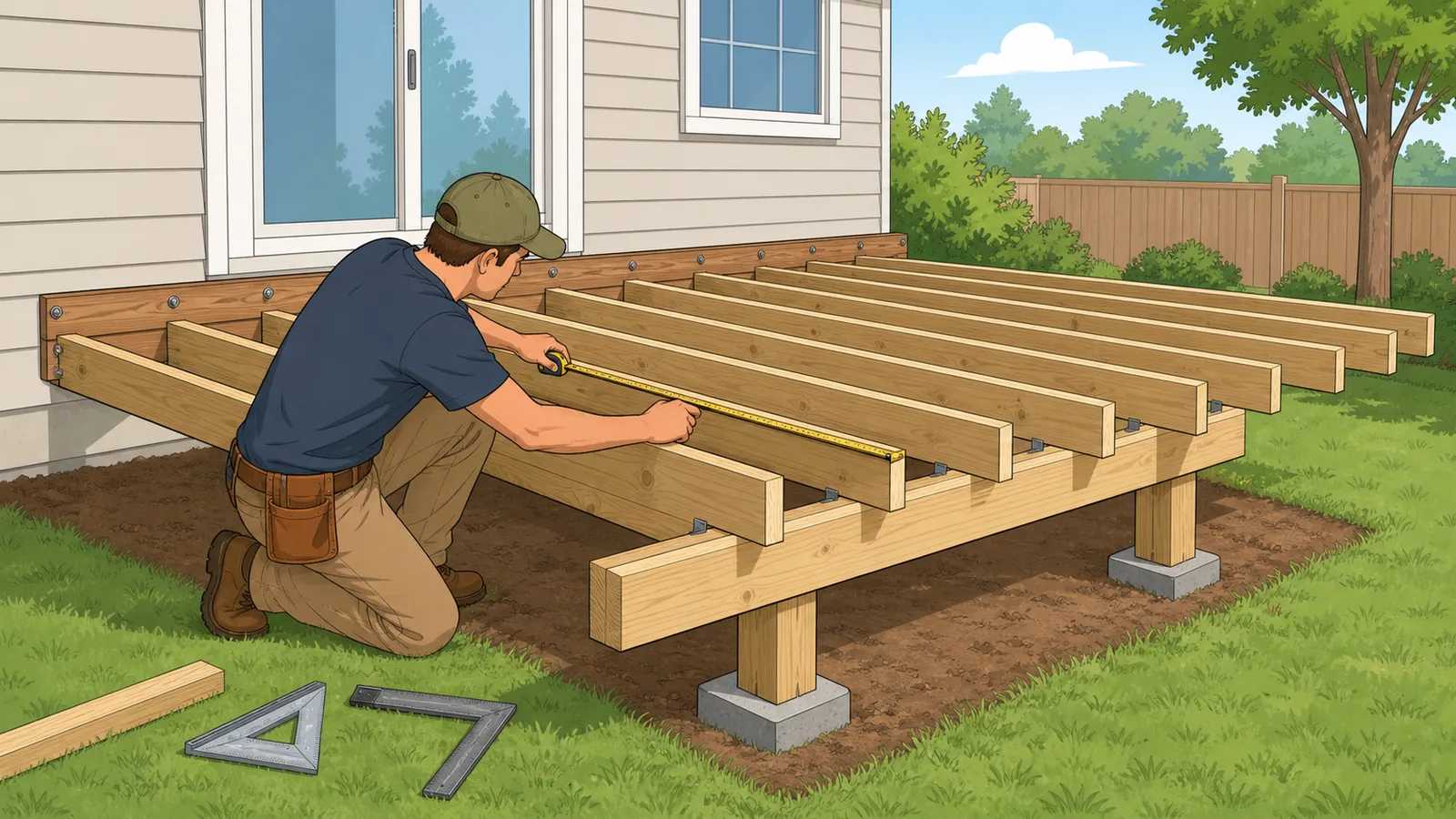
A joist span calculator helps you look up how far a deck joist can span before you lock in beam placement, ledger height, and framing layout. This version is a U.S.-specific deck joist span calculator built around AWC DCA 6 Table 2, so it is best for residential deck joists where you know the species group, joist size, joist spacing, and the planned clear span you want to check.
What this joist span calculator is actually doing
This is a prescriptive table lookup, not a free-form structural solver. The calculator checks the selected species group, joist size, and joist spacing against AWC DCA 6 Table 2 and returns the maximum joist span plus the published allowable overhang for that row.
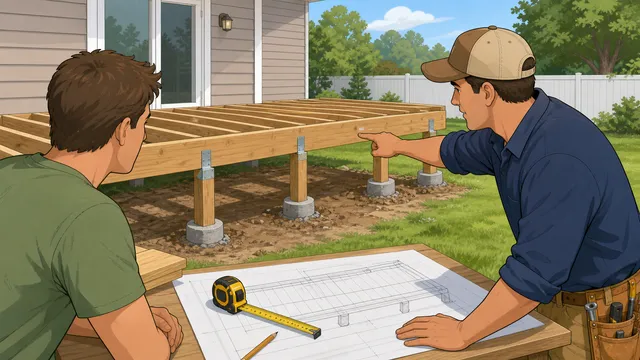
That makes it useful when you are sketching a deck framing plan and want to know whether a joist size will carry the deck depth you have in mind before you finalize beam lines or post spacing. The worksheet also lets you enter a planned clear span so the result is not just a table value; it tells you whether the selected row fits and how much margin remains.
How the table basis works
In the AWC residential deck guide, joist span depends on the wood species group, joist size, and on-center spacing. The table assumes residential deck loading and wet-service conditions, so the public worksheet does not ask for separate live load, dead load, or deflection settings.
The same table also publishes an allowable joist overhang. That overhang still has to respect the rule that the actual cantilever cannot exceed one quarter of the actual main span, so the printed overhang value is not a license to cantilever farther than the framing layout allows.
Maximum joist span = table lookup by species group, joist size, and spacing
The public worksheet follows AWC DCA 6 Table 2 instead of deriving a custom span from section properties and load inputs.
Allowable overhang = lesser of table value or one quarter of the actual main span
The deck guide publishes a maximum overhang value, but the actual cantilever also stays limited by the one-quarter-of-span rule in the source guidance.
Checking a planned deck depth against the table
Many searchers arrive with a practical question such as "how far can a 2x10 joist span" or "will 2x8 deck joists work at 16 inches on center?" The planned-span fields are designed for that decision. Enter the unsupported clear span between bearing faces, then compare the pass-or-fail status and margin against the maximum table row.
A positive margin means the planned deck joist span is inside the selected AWC DCA 6 row. A negative margin means the deck depth is longer than the selected row supports under the table assumptions. In that case, compare the joist size table and spacing table before you move the beam line, switch to a larger joist, or tighten spacing.
Use the size comparison rows to see whether a 2x8, 2x10, or 2x12 option clears the same planned span.
Use the spacing comparison rows to see the difference between 12, 16, and 24 inches on center for the selected joist size.
Use the allowable overhang result separately; it does not increase the clear span between supports.
Worked example
Suppose you are planning a U.S. residential deck with Southern Pine No. 2 joists, 2x10 members, and 16-inch on-center spacing. In AWC DCA 6 Table 2, that combination gives a maximum joist span of 14 feet 0 inches and an allowable overhang of 3 feet 5 inches.
If your planned clear span is exactly 14 feet, the selected row fits with no spare span margin. If you change the planned clear span to 15 feet, the same 2x10 row is too short by 1 foot. That immediate margin check is more useful than reading a deck joist span table alone because it connects the table row to the actual deck depth you are testing.
The allowable overhang remains a separate limit. The joists can span up to 14 feet between supports under the table assumptions, and the deck can project farther only within the published overhang and one-quarter-span limits. If you need a longer reach, compare a larger joist size or tighter spacing rather than stretching the same row past the table value.
Deck joist span calculator versus floor joist span calculator
Deck joist span and floor joist span searches overlap, but they are not the same design intent. This page owns the residential deck joist span calculator intent because it follows the AWC DCA 6 deck table, including wet-service assumptions and deck-specific overhang guidance. Interior floor joist span calculators usually reference floor loading, deflection limits, subfloor assumptions, and room-use conditions instead.
If you are framing an interior floor, use a floor joist span calculator or the current code table that applies to the floor system. If you are sizing a deck beam, use a beam span calculator after the joist span is known, because deck beams are selected from different AWC DCA 6 tables.
How to interpret 12, 16, and 24 inch on-center spacing
Joist spacing changes the tributary load carried by each joist. A 12 inch on-center row generally spans farther than a 16 inch on-center row for the same joist size and species group, while 24 inch on-center spacing generally gives a shorter allowable span. That is why the spacing comparison table is a useful scenario planner rather than just a repeated result.
Spacing also affects the decking surface. Some decking products, diagonal decking layouts, or composite boards require closer spacing than the framing span table alone might suggest. Treat the joist span result as one structural screen, then check the decking manufacturer's span and installation requirements before finalizing spacing.
What this result does not cover
This calculator does not design interior floor joists, ceiling joists, roof rafters, hot-tub framing, snow-load exceptions, or engineered framing outside the deck-guide assumptions. It also does not check connections, hangers, bearing length, beams, posts, or footing sizes.
If your project has unusual loads, local amendments, heavy finishes, diagonal decking, a hot tub, masonry surfaces, or framing conditions outside the published assumptions, the prescriptive result is no longer enough on its own and should be checked against the current code tables or by a qualified professional.
Frequently asked questions
Is this a general floor joist span calculator?
No. This version is a U.S. residential deck joist lookup based on AWC DCA 6 Table 2. It is useful for prescriptive deck planning, but it is not a substitute for engineered interior floor or roof framing design.
Why does the result include allowable overhang?
Because the AWC deck table publishes both the main joist span and a matching maximum overhang value. The actual overhang still cannot exceed one quarter of the actual main span in the framing layout.
How far can a 2x10 deck joist span?
It depends on species group and spacing. Under AWC DCA 6 Table 2, Southern Pine No. 2 2x10 joists span up to 16 feet 2 inches at 12 inches on center, 14 feet 0 inches at 16 inches on center, and 11 feet 5 inches at 24 inches on center. Other species groups have different rows.
How far can a 2x8 deck joist span?
The answer depends on the wood species group and joist spacing. For example, Southern Pine No. 2 2x8 joists in the AWC deck table span up to 13 feet 1 inch at 12 inches on center, 11 feet 10 inches at 16 inches on center, and 9 feet 8 inches at 24 inches on center.
Should I choose 12, 16, or 24 inches on center?
Sixteen inches on center is a common residential deck planning baseline, but tighter 12 inch spacing can increase the allowable joist span and may be needed for some decking products. Twenty-four inch spacing can reduce framing quantity but gives shorter allowable spans and may not work with every decking material.
What does the planned span margin mean?
The planned span margin is the selected table maximum minus the clear span you entered. A positive or zero margin means the planned clear span fits the selected row. A negative margin means the selected joist size, species group, and spacing do not clear that planned span under the table assumptions.
Can I use the maximum span exactly as my joist layout?
You can use it as the prescriptive maximum under the same assumptions, but you still need the rest of the deck framing to work with that layout, including beam locations, ledger details, hangers, posts, and footings.
Why do some 2x12 rows stop at 18 feet exactly?
The source guide notes that some joist lengths are prescriptively limited to 18 feet for footing design. That is a limit of the prescriptive deck guide, not necessarily the absolute structural limit of every possible engineered framing case.
Can I use the overhang value to make the deck deeper?
Only within the source guide's overhang rules. The clear span between supports still has to be within the allowable joist span row, and the overhang is separately limited by the published value and by one quarter of the actual main span.
Does this calculator cover hot tubs or heavy deck loads?
No. Hot tubs, masonry finishes, unusually heavy planters, concentrated loads, and many snow-load cases fall outside this simple deck joist span calculator. Those cases need the current code tables, manufacturer guidance, or an engineered design.