Calculate ibuprofen dose for adults and children by age and weight, with mg/kg guidance, child liquid mL conversion, daily limits, and key NSAID safety stops.
Health estimate
Editorial responsibility: Calcipedia editorial team
This page is maintained against the site trust model for its topic and updated when formulas, sources, or guidance materially change.
OTC adult dosing selected: 200 to 400 mg every 4 to 6 hours, with a 1,200 mg/day nonprescription ceiling.
Read the Drug Facts or leaflet for the exact tablet/capsule strength and maximum 24-hour limit.
Important notes
• Take with food, milk, or antacids to reduce stomach upset.
• Avoid combining with other NSAIDs (aspirin, naproxen). Do not use for more than 10 days for pain or 3 days for fever without medical advice.
Medical disclaimer This is general guidance only. Consult a pharmacist or doctor before use, especially for children, pregnancy, or those with chronic conditions. Do not use alongside other NSAIDs without medical advice.
Ibuprofen dosage calculator guide: adult and child dosing, mg/kg ranges, and safety stops
Ibuprofen dosing depends on age, body weight, product strength, and whether there are reasons not to use an NSAID at all. This page also explains the main assumptions behind the ibuprofen dosage calculator result, highlights the supporting figures shown by the calculator, and helps the reader use the estimate without overstating what a quick online tool can prove.
How this calculator estimates an ibuprofen dose
For adults and adolescents aged 12 years and over, this page uses a common over-the-counter range of 200 to 400 mg per dose and a higher prescription-strength ceiling only when that option is selected. For children from 6 months to 11 years, it switches to weight-based dosing at 5 to 10 mg per kilogram per dose, with a weight-based daily ceiling.
That is only a structured estimate. Real products differ, and some people should avoid ibuprofen entirely. NHS consumer advice and FDA labelling both stress that the pack instructions, age limits, and maximum 24-hour dose for the product in hand should override a generic calculator.
Paediatric single dose = 5 to 10 mg/kg
This is the weight-based starting range used by the calculator for infants over 6 months and children under 12 years.
Paediatric daily ceiling = up to 40 mg/kg/day
The calculator caps the total daily amount using a common paediatric limit, but actual label directions still matter.
Liquid mL = target mg ÷ (label mg per 5 mL ÷ 5)
For children, the calculator converts the milligram range to millilitres only after you enter the exact liquid strength printed on the bottle.
Why adult and child dosing are handled differently
Adult dosing is usually expressed as a fixed milligram amount per dose because most OTC tablet and capsule products are built around standard strengths such as 200 mg or 400 mg. Child dosing is different because the safer dose depends more directly on body weight and on the exact liquid or chewable formulation being used.
That is why strong ibuprofen pages talk about both milligrams and product strength. A calculator can tell you the target milligrams, but parents still need to match that number to the suspension or tablet strength actually in hand and to the label directions for the specific product.
Converting child ibuprofen from mg to mL
Many child ibuprofen searches are really asking for the liquid amount, not just the milligram dose. The calculator therefore lets you enter the liquid strength, such as 100 mg/5 mL children’s suspension or 50 mg/1.25 mL infant drops, and then shows an estimated mL range alongside the weight-based milligram range.
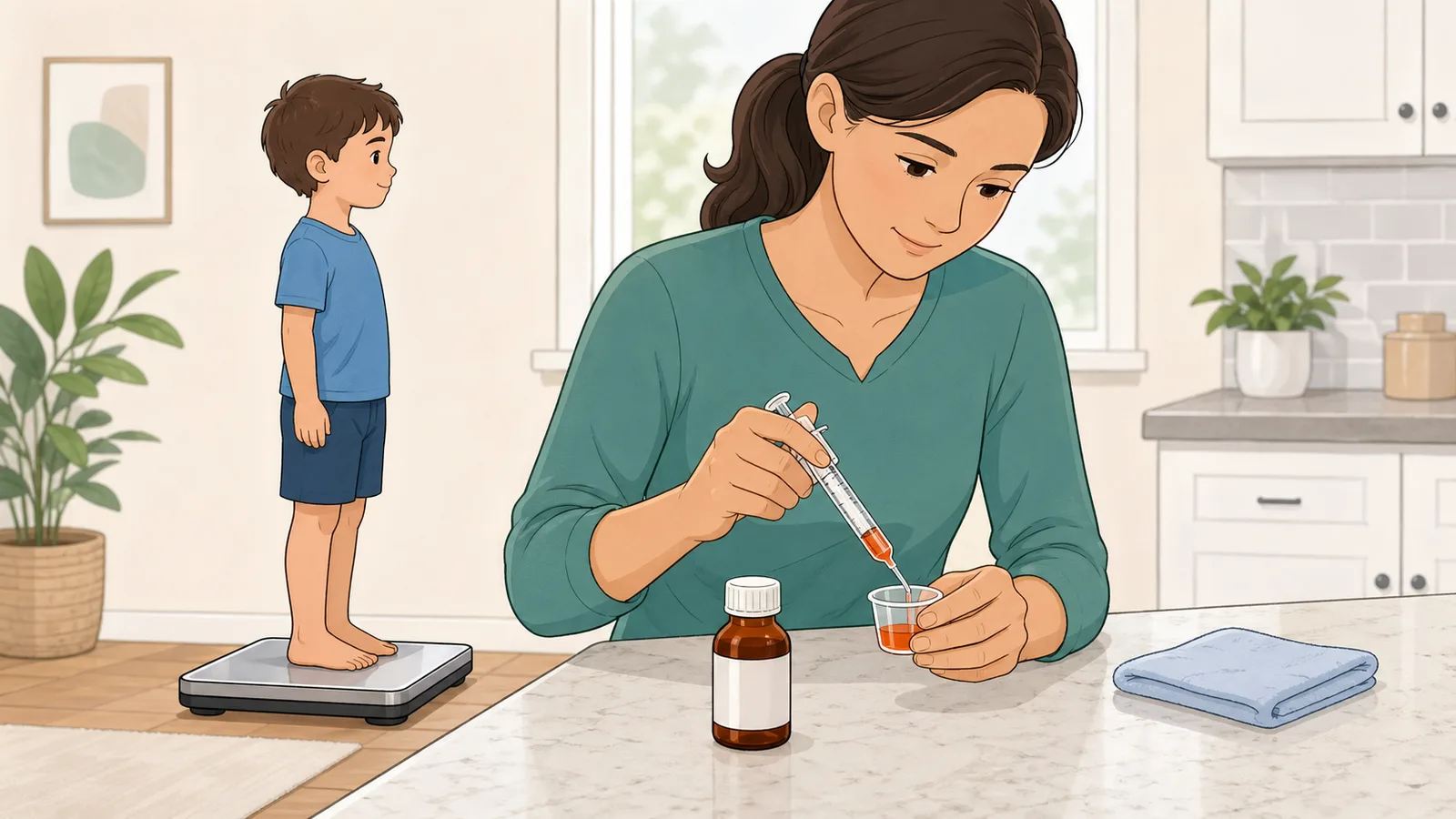
That conversion is useful only when the label strength is checked first. Ibuprofen liquids are not all the same concentration, and country-specific products may differ from US or UK examples. Use the oral syringe or dosing cup supplied with the medicine rather than a kitchen spoon, and do not mix the dose into a full drink that the child may not finish.
Find the child’s weight-based milligram dose first.
Read the bottle for the exact concentration, usually written as mg per 5 mL or mg per 1.25 mL.
Convert using the labelled concentration, then compare the result with the product’s own age and weight chart before giving a dose.
Worked example: child ibuprofen dose by weight
Suppose a child weighs 25 kg and the product label says 100 mg/5 mL. The calculator’s 5 to 10 mg/kg range gives a single-dose range of 125 to 250 mg. Because that liquid contains 20 mg per mL, the measured amount is about 6.3 to 12.5 mL per dose before comparing the result with the bottle’s own chart and maximum daily directions.
This example also shows why the page uses a range rather than a false-precision single answer. A clinician, pharmacist, or product label may choose a dose within the range based on the reason for treatment, the child’s age band, dose history, and whether the child is dehydrated or has another NSAID risk factor.
Ibuprofen is an NSAID, so it does more than reduce pain and fever. It can also increase stomach bleeding risk, worsen kidney function, raise fluid retention, and trigger bronchospasm or allergic reactions in some people who react to aspirin or other NSAIDs. That is why this page treats major contraindications as a stop signal rather than simply lowering the dose.
Pregnancy is another important example. FDA labelling already warns against use during the last 3 months of pregnancy unless a clinician specifically directs it, and FDA safety communication also recommends avoiding NSAIDs from 20 weeks of pregnancy unless a healthcare professional advises otherwise. The calculator therefore works best for general educational planning, not for deciding suitability in higher-risk patients.
The safety-stop checkboxes deliberately block dosing output for common high-risk situations such as pregnancy after 20 weeks, dehydration or kidney-risk contexts, and duplicate NSAID or blood-thinner use. That is more cautious than a plain dose chart, but it better matches how ibuprofen should be used in real households where the dose and the suitability question are often mixed together.
When this page is not enough
Children under 6 months, people with active ulcers or GI bleeding, known NSAID allergy, severe kidney disease, heart failure, dehydration, or suspected overdose need clinician or pharmacist advice rather than a generic dose estimate. The same applies if the patient is taking anticoagulants, lithium, methotrexate, or other NSAIDs.
If the goal is to alternate ibuprofen with acetaminophen, a calculator can only go so far. The safer approach is to use one medicine at a time if possible, keep a written record of what was given and when, and confirm the schedule with a pharmacist or clinician when treating children or medically complex adults.
Take oral ibuprofen with or after food when possible to reduce stomach upset.
Do not combine ibuprofen with another NSAID unless a clinician has explicitly told you to do so.
If the patient has black stools, vomiting blood, severe abdominal pain, wheeze after NSAIDs, or reduced urine output, seek urgent medical advice.
Frequently asked questions
Can I take ibuprofen with acetaminophen?
They can sometimes be used together or alternated because they work differently, but the schedules should not be improvised casually, especially for children. Keep the dosing intervals for each medicine separate, write down what was given, and get pharmacist or clinician advice if the patient has kidney disease, liver disease, dehydration, or ongoing fever or pain.
How long can I use OTC ibuprofen?
NHS and FDA-style consumer advice is to use the smallest dose you need for the shortest time you need it. For OTC use, people are generally advised not to keep taking ibuprofen for more than about 10 days for pain or 3 days for fever without medical review.
Why is ibuprofen avoided late in pregnancy?
Ibuprofen and other NSAIDs can cause fetal and maternal complications later in pregnancy. FDA labelling warns against use during the last 3 months of pregnancy unless a doctor specifically directs it, so pregnancy should be treated as a clinician-review situation rather than a routine self-dosing decision.
Can I take ibuprofen with another NSAID such as naproxen?
Usually no, unless a clinician has specifically told you to. Doubling up NSAIDs increases the chance of stomach bleeding, kidney injury, and other adverse effects without simply behaving like a safer stronger dose.
Can children under 6 months use ibuprofen?
That should not be treated as a routine calculator situation. Babies under 6 months need clinician or product-specific advice because age cutoffs and formulations differ, and fever in very young infants can need urgent assessment.
How do I convert a child ibuprofen dose from mg to mL?
First calculate or confirm the milligram dose, then divide by the liquid concentration in mg per mL. For example, a 100 mg/5 mL suspension contains 20 mg per mL, so a 200 mg dose would be 10 mL. Always check that the bottle strength you enter matches the product in hand.
What if the child is dehydrated, vomiting, or not drinking well?
Do not treat that as a routine ibuprofen-calculator situation. Dehydration, vomiting, poor fluid intake, kidney disease, or heart failure can increase NSAID kidney risk, so pharmacist or clinician advice is safer before giving ibuprofen.
Is 50 mg/1.25 mL the same as 100 mg/5 mL?
No. A 50 mg/1.25 mL product contains 40 mg per mL, while a 100 mg/5 mL product contains 20 mg per mL. The same mL amount would give twice as much ibuprofen from the more concentrated product, which is why liquid strength must be checked before measuring.