Use this GLP-1 weight loss calculator to compare trial-average results at 3, 6, 12, and
18 months for Wegovy, Zepbound, Ozempic, Mounjaro, and Saxenda. It turns published
percentages into projected body weight at the same starting weight so you can compare
trajectories instead of guessing from anecdotes.
What this page helps you compare Use the selector to compare semaglutide and tirzepatide trial averages on the same scale,
then read the chart and comparison table to see how the same starting weight changes over
time. This is a planning tool, not a prediction of your personal response.
Quick examples
Unit
Projection result
187.22 lbs
Wegovy at 18 months from a 220 lbs
starting weight. Clinical trial averages. Roughly 50% of participants lose more than the median; about 15–20% are non-responders. Individual results depend on diet, activity, and adherence.
207.02 lbs
3 months
−12.98 lbs (5.9%)
197.34 lbs
6 months
−22.66 lbs (10.3%)
189.64 lbs
12 months
−30.36 lbs (13.8%)
187.22 lbs
18 months
−32.78 lbs (14.9%)
Projected BMI at 18 months
28.47
From 33.45 to 28.47 using the entered height.
BMI category band
25.0 to 29.9
BMI is only a screening context. It does not measure body composition, side effects, eligibility, or treatment suitability.
Projected weight trajectory
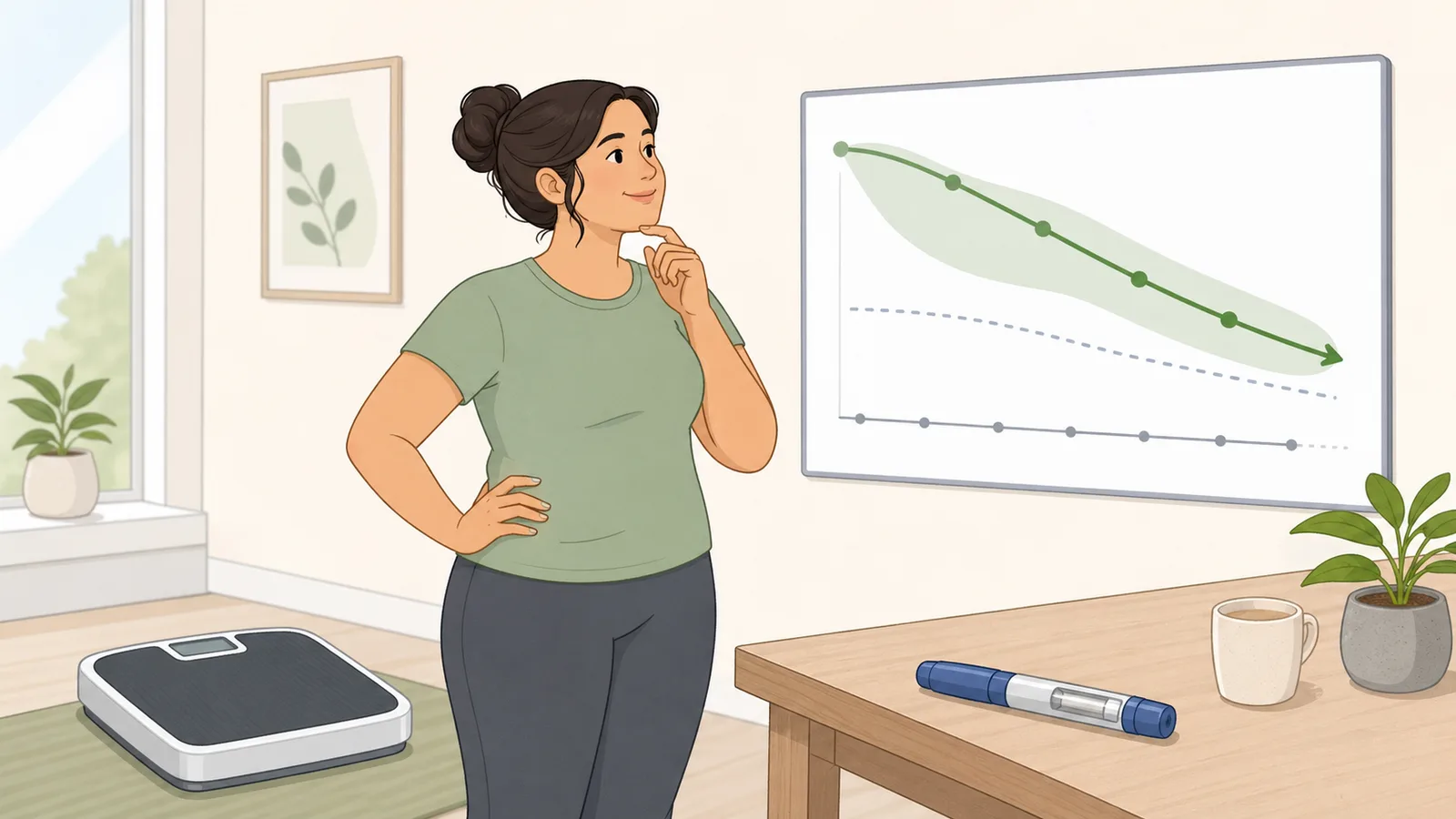
The chart shows the selected medicine's average trajectory at the same starting
weight. It is a trial-average line, so the shape helps with planning but it does not
predict your personal response.
How the major GLP-1 brands compare at the same starting weight
The table is sorted by 18-month average weight lost. Weight-management brands and
diabetes-label comparators stay visible together so you can compare the evidence
without treating every row as interchangeable.
Brand
Label context
Route
12 months
18 months
Zepboundtirzepatide 5–15 mg
Weight-management brand
Weekly injection
177.54 lbs
−42.46 lbs (19.3%)
174.02 lbs
−45.98 lbs (20.9%)
Wegovysemaglutide 2.4 mg
Weight-management brand
Weekly injection
189.64 lbs
−30.36 lbs (13.8%)
187.22 lbs
−32.78 lbs (14.9%)
Mounjarotirzepatide 5–15 mg
Diabetes-label comparator
Weekly injection
192.5 lbs
−27.5 lbs (12.5%)
190.74 lbs
−29.26 lbs (13.3%)
Saxendaliraglutide 3 mg
Weight-management brand
Daily injection
202.4 lbs
−17.6 lbs (8%)
202.84 lbs
−17.16 lbs (7.8%)
Ozempicsemaglutide 0.5–2 mg
Diabetes-label comparator
Weekly injection
208.34 lbs
−11.66 lbs (5.3%)
207.02 lbs
−12.98 lbs (5.9%)
Rybelsusoral semaglutide 14 mg
Diabetes-label comparator
Daily oral
210.76 lbs
−9.24 lbs (4.2%)
210.76 lbs
−9.24 lbs (4.2%)
Milestone planner for the selected medicine
Use the 5%, 10%, 15%, and 20% checkpoints to translate trial-average percentages into
a rough calendar plan. If a row says not reached by 18 months, the medicine did not
hit that milestone in the selected trial-average curve.
Milestone
Projected weight
Weight lost
Estimated month
5% milestone
209 lbs
−11 lbs
2.54 months
10% milestone
198 lbs
−22 lbs
5.8 months
15% milestone
187 lbs
−33 lbs
Not reached by 18 months
20% milestone
176 lbs
−44 lbs
Not reached by 18 months
How to read this result
A larger starting weight usually means a larger absolute number of pounds or kilograms
lost for the same percentage, but the percentage itself is still the right way to
compare the brands. If you are trying to decide between semaglutide and tirzepatide,
use the chart and the table together.
GLP-1 weight loss calculator: Wegovy, Zepbound, Ozempic, and Mounjaro trial averages
This GLP-1 weight loss calculator estimates trial-average weight loss at 3, 6, 12, and 18 months using published results from major studies of obesity-label medicines and closely related diabetes-label products.
What average weight loss did Wegovy and Zepbound trials report?
The strongest starting point is the pivotal-trial average, not anecdotal before-and-after stories. Wegovy (semaglutide 2.4 mg) produced mean weight loss of about 14.9% at 68 weeks in STEP 1, while Zepbound (tirzepatide) produced larger mean losses in SURMOUNT-1 at the highest dose. Saxenda (liraglutide 3 mg) produced smaller but still clinically meaningful average weight loss in the SCALE programme.
Those numbers explain why searches such as how much weight can I lose on Wegovy or how much weight can I lose on Zepbound often lead to trial-based tools. The useful comparison is not just the peak percentage, but also how the average loss builds over time at roughly 3, 6, 12, and 18 months.
What a GLP-1 weight loss timeline usually looks like
Many people expect the biggest change in the first few weeks, but the typical GLP-1 weight loss timeline is slower and more layered than that. Early progress often happens during dose escalation, then continues as patients reach and tolerate higher maintenance doses. That is why 3-month, 6-month, and 12-month checkpoints are more useful than expecting the final result immediately.
A trial-average timeline also helps set realistic expectations. A person may lose meaningful weight in the first few months and still be far from their eventual 12- or 18-month average. That does not mean the medicine has failed. It often reflects the fact that semaglutide and tirzepatide programmes are designed around gradual titration rather than abrupt full-dose treatment from day one.
Why the same percentage can mean very different pounds or kilograms
A 10% reduction is the fairest way to compare medicines, but it does not feel the same on every body. Someone starting at 300 lb can lose far more absolute pounds than someone starting at 180 lb even when both follow the exact same percentage curve. That is why the calculator keeps the percentage logic in the background and translates it into projected weight and weight-lost figures at your own starting weight.
This also explains why comparison tables should be built from one shared starting weight. If two brands are shown on different starting weights, the absolute loss numbers become misleading very quickly. A same-starting-weight comparison sheet lets you see whether the difference is coming from the medicine’s trial-average percentage or just from a heavier baseline.
How projected BMI adds context without deciding treatment
Some GLP-1 weight loss calculators ask for height because users want to know whether an estimated loss would move their BMI category as well as the scale number. That context can be helpful when comparing a starting BMI with a projected BMI after 12 or 18 months, especially for searches around Wegovy weight loss, Zepbound weight loss, and whether a trial-average percentage is clinically meaningful.
BMI is still only a screening measure. It does not measure muscle, fat distribution, side effects, nutrition quality, eligibility, insurance coverage, or whether a medicine is appropriate. Use the projected BMI row as an interpretation aid beside the weight projection, not as a prescription decision or a promise that a specific category change will happen.
Why Ozempic and Mounjaro estimates need extra context
This page also shows estimates based on lower-dose diabetes-label products such as Ozempic and Mounjaro, but those should not be read as direct equivalents to Wegovy and Zepbound. Their approved indications, doses, and trial populations differ. In plain terms, an Ozempic weight loss calculator or Mounjaro weight loss calculator is often answering a different clinical question from a Wegovy or Zepbound calculator.
That distinction matters because people often compare the brand names before they compare the dose and trial design. The same active molecule at a different dose, or the same molecule studied in a diabetes population instead of an obesity trial, can produce a different average result. If you are comparing Wegovy vs Zepbound, comparative evidence tends to favor tirzepatide for greater average weight loss, but this page is deliberately built to show the trial averages rather than turn that comparison into a promise about your own response.
How to use 5%, 10%, 15%, and 20% milestones
Many clinicians and patients talk about milestones rather than only the final 18-month average. A 5% change can feel like the first meaningful checkpoint, 10% is often discussed as a more obvious clinical milestone, and 15% to 20% is where people start comparing stronger obesity-label results against the most effective current options. A milestone planner turns those percentages into estimated body weight and rough time-to-milestone rather than leaving you to do the conversion mentally.
Those milestone rows are especially useful when you are trying to set expectations for follow-up appointments. Instead of asking whether a medicine works in the abstract, you can ask whether the trial-average curve would put a 5% or 10% checkpoint before a given month, and whether a higher milestone is even reached by the 18-month mark in the published data.
What this page can and cannot tell you
This calculator does not tell you whether you should take a GLP-1 medicine, whether you meet prescribing criteria, whether insurance will cover it, or whether a specific brand is appropriate for you. Those decisions depend on indication, contraindications, treatment history, side-effect tolerance, country rules, and clinician judgement.
It also does not model adverse effects, missed doses, medication switching, body-composition changes, or the common pattern of weight regain after treatment stops. Dose reached, adherence, baseline weight, diet quality, sleep, activity, and tolerance all influence real-world results. Treat the output as a population reference point rather than a forecast of your own response.
Frequently asked questions
Which trial reported the largest average weight loss?
Among the widely cited pivotal trials, the highest average percentage losses were reported in tirzepatide studies at the highest dose, and newer comparative evidence still generally points the same way. But those figures come from trial populations under study conditions, not from a guarantee of what any one person will lose in routine practice.
How much weight can I lose on Wegovy or Zepbound in 3 or 6 months?
In the major trials, average weight loss was already visible by the 3-month mark and became much larger by 6 months, but the exact percentage depended on the medicine and dose studied. This calculator translates those trial averages into projected body weight at each checkpoint so you can compare the scale of change rather than guessing from anecdotal stories.
Why does weight loss often speed up after dose escalation?
Most GLP-1 medicines are started at lower doses to improve tolerability, not to deliver the full maintenance effect immediately. As patients titrate upward, appetite suppression and average body-weight change often become more pronounced. That is why trial timelines usually show progressive loss over months rather than a single dramatic first-month result.
Do you regain weight when you stop GLP-1 medication?
Weight regain after stopping treatment is common. That is one reason these medicines are usually discussed as part of long-term weight-management planning rather than as a short one-off intervention.
Why does the calculator show the same starting weight for every brand comparison?
Because that is the cleanest way to compare the medicines themselves rather than the people taking them. A heavier starting weight naturally produces a larger absolute number of pounds or kilograms lost for the same percentage change, so using one shared baseline keeps the comparison focused on the trial-average percentage differences.
What does it mean if a 15% or 20% milestone is not reached by 18 months?
It means the selected trial-average curve did not cross that threshold within the longest timepoint shown on the page. That does not prove an individual patient can never reach it, but it does mean the published average used here does not support that milestone within the displayed follow-up window.
Can two people on the same medicine lose very different amounts?
Yes. Trial averages hide a wide spread of individual responses. Some people lose substantially more than the average, some lose less, and some stop treatment early or do not respond strongly. That is why the page uses trial averages as a planning reference rather than claiming to predict your personal outcome.
Why do Ozempic and Mounjaro usually look weaker here than Wegovy and Zepbound?
Because the figures shown for Ozempic and Mounjaro come from diabetes-label populations and lower-dose or different-label evidence, not the obesity-label trials used for Wegovy and Zepbound. The result is still useful for context, but it is not an apples-to-apples label comparison.
Should I compare monthly progress directly with this calculator?
Only loosely. The page estimates 3-, 6-, 12-, and 18-month trial-average checkpoints and interpolates milestone timing from those published curves. Real progress often moves unevenly because titration schedules, side effects, food intake, exercise, and dose interruptions can change the shape of the curve.
Why does this GLP-1 weight loss calculator show averages instead of a personal forecast?
Because the strongest evidence comes from published trial averages, not from a model that pretends it can predict your exact response. Dose reached, adherence, adverse effects, baseline weight, lifestyle, and whether treatment is continued all change outcomes in ways a simple page calculator cannot individualise safely.
Why does the GLP-1 weight loss calculator ask for height?
Height lets the calculator add optional BMI context beside the projected weight. That can make a Wegovy, Zepbound, semaglutide, or tirzepatide estimate easier to interpret, but BMI is not a medication-eligibility decision, a body-composition measurement, or a guarantee that a trial-average result will happen for one person.