Estimate deck stain or sealer volume, finish-type coverage rate, container count, leftover stain, and product cost from deck floor area, add-on coated surfaces.
Last updated
Deck stain coverage planner Estimate stain or sealer volume from deck floor area, add-on coated surfaces, surface texture, coats, and product coverage so you can order enough tins without overspending heavily.
Quick examples
Try a maintenance coat, a weathered family deck, or a rough deck with railings and other add-on surfaces.
Coverage guidance
A common deck-stain planning baseline for visible grain and moderate colour.
Smooth boards usually spread farther than rough or weathered wood. If your product label gives a range, use the lower end for rough timber and add-on surfaces like railings or stairs.
Enter deck dimensions Start with the deck floor size, then add railings, stairs, or benches if they will be coated separately.
Deck stain gallons, coverage ranges, add-on surfaces, and order planning
A deck stain calculator helps you estimate how much stain or sealer to buy before you start coating the deck. It converts deck floor area, add-on coated surfaces, surface texture, coats, product coverage, container size, and waste allowance into a practical order volume, whole-container count, and optional material-cost estimate.
What this deck stain calculator is estimating
Stain and sealer products are usually sold by coverage rate, but real use depends on the deck floor area, any extra coated surfaces, how many coats you apply, and how absorbent the boards are. A deck stain calculator bridges that gap by starting with the finished floor area and then adjusting it for the practical coverage load created by texture, weathering, and multiple coats.
That makes this kind of deck stain coverage calculator useful for timber-deck refresh projects, new decking, resealing work, and early maintenance budgeting. It helps you compare whether one or two tins are enough, whether you need to round up for a second coat, and how much of the result is driven by the board surface rather than the floor area alone.
Core deck stain formulas
The deck floor area is multiplied by any add-on coated area, then adjusted for the number of coats and a surface-profile factor. That adjusted coverage load is divided by the product coverage rate to estimate the liquid finish needed, and waste is then applied so the order volume reflects a practical buy quantity rather than a perfect-label calculation.
Deck floor area = Length x Width
The starting point is the deck surface itself, measured in the calculator's current area unit.
Total coated area = Deck floor area + Additional coated area
Railings, stairs, benches, and other add-on surfaces can be measured separately and included in the estimate.
Adjusted coverage load = Total coated area x Coats x Surface multiplier
Weathered, rough, or grooved boards usually consume more product than smooth new decking.
Order volume = (Adjusted coverage load / Coverage rate) x (1 + Waste%)
The finish quantity is rounded into a practical ordering figure after applying the waste allowance.
Coverage rates and wood condition
Coverage rate is the biggest variable in any deck stain estimate. Smooth, newer boards usually spread farther than rough-sawn or heavily weathered boards, and transparent or semi-transparent products often cover differently than solid-color systems.
If your product label gives a coverage range, use the lower end for rough timber, heavily sanded areas, or surfaces with more end grain. That is the safest way to turn a deck stain calculator result into a purchase plan without running short on the job.
Deck stain coverage by finish type
The finish-type preset in the calculator is a starting point for choosing a coverage rate, not a substitute for the label on the product you buy. Transparent sealers and semi-transparent stains often spread farther because they leave more wood grain visible, while semi-solid and solid-color stains tend to use more product per square foot because they build a heavier film.
Use the preset when you are still comparing products, then switch to the exact label rate before purchasing. This keeps the estimate useful for early planning while still letting the final deck stain gallons calculator result follow the brand, finish opacity, wood condition, and container size you actually choose.
Railings, stairs, and add-on surfaces
The calculator includes an extra coated-area field for railings, stairs, benches, or similar add-ons because those surfaces can add a lot of finish demand even when the deck floor itself is modest. Measuring them separately keeps the estimate closer to the real staining job instead of pretending every project is only a flat deck surface.
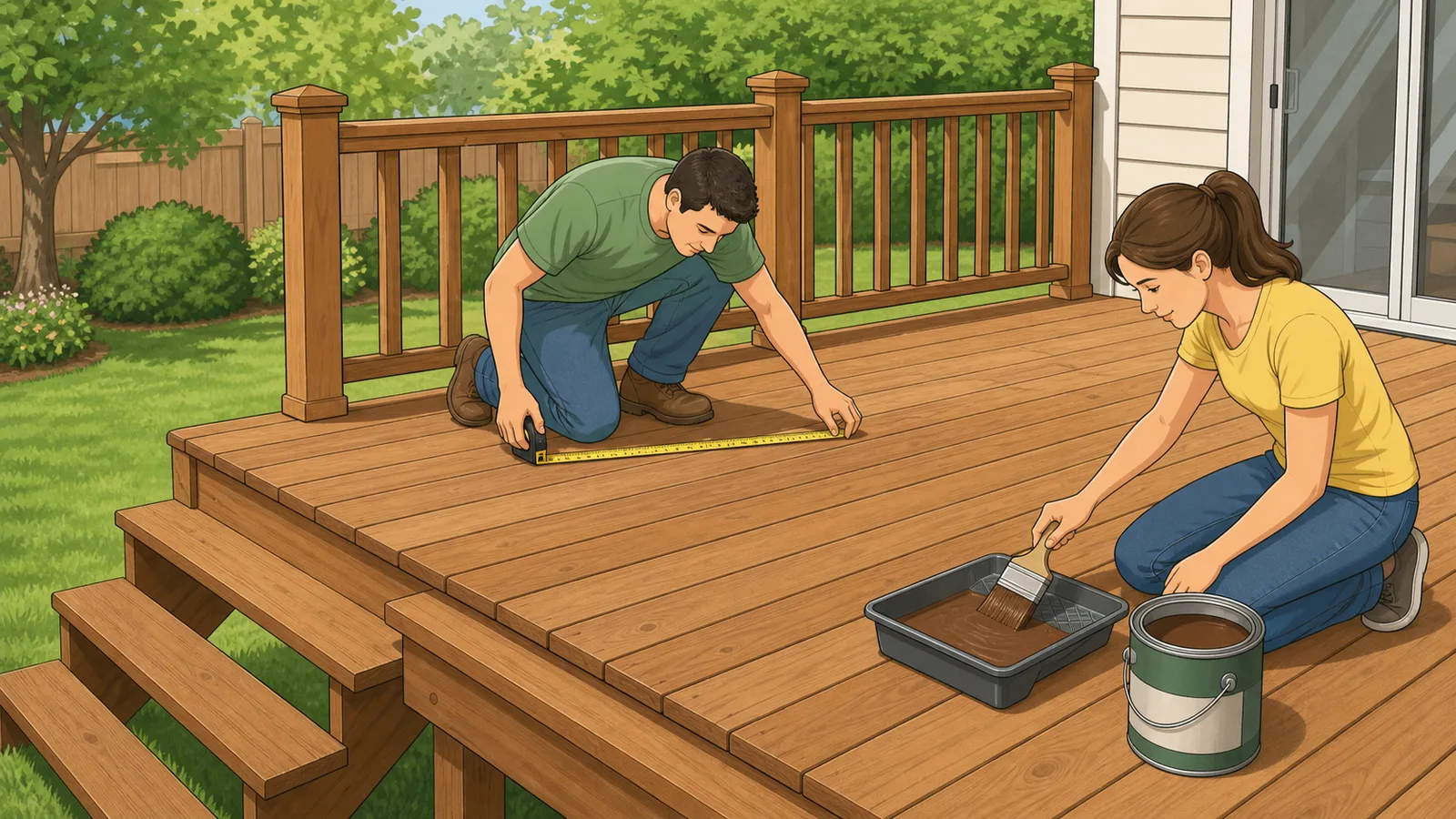
For railings, a practical approach is to estimate the visible faces of rails, posts, and balusters, then enter that total as additional coated area. For stairs, include treads, risers, stringer faces, and any exposed edges you plan to stain. These details are why a deck stain calculator with railings and stairs can produce a very different answer from a floor-only square-footage shortcut.
For example, a 16 ft by 12 ft weathered deck with 40 ft² of extra coated area, 2 coats, 250 ft² per gallon coverage, and 10% waste needs about 2.35 gallons, which rounds up to 3 standard 1 gallon containers.
How to use the order volume
Use the order volume as your buying baseline, then compare it with the product label and the real deck construction. If the project includes railings, stairs, fascia, underside boards, or heavy end grain, the calculator's add-on area field helps bring those extras into the order estimate instead of leaving them to guesswork.
The quick examples are there to show common scenarios: a smooth maintenance coat, a weathered family deck, and a rough deck with more coated surface. That gives you a fast way to compare the order volume against the size of the tins or buckets on the shelf.
Application planning tips
A deck stain calculator is only the buying step. Real project success still depends on dry wood, suitable temperature, no rain in the forecast, and a finish method that matches the product instructions. Back-brushing, product open time, and the actual absorbency of the boards can all change the final spread rate.
If the deck is very rough or gray from weathering, it is worth treating the calculator result as a minimum rather than a target. That is especially true for older boards, sharp end grain, and areas that will get a second pass because the first coat disappears quickly.
What this result does not cover
This is a deck-floor stain estimate, not a full coating schedule. It does not automatically model the exact finish demand of every handrail, baluster, spindle, stair tread, or underside board unless you add those surfaces into the extra coated-area field.
Use it as a deck-stain purchasing tool, then confirm final coverage, product selection, and preparation requirements with the chosen finish label before buying.
Frequently asked questions
How much deck stain do I need?
That depends on the deck floor area, any extra coated area, the number of coats, the surface profile, and the label coverage rate of the chosen product. This calculator combines those inputs and returns an order volume plus a whole-container count.
What coverage rate should I use for deck stain?
Use the coverage rate printed on the product label first. If the label gives a range, choose the lower end for rough or weathered timber and for projects with railings, stairs, or other add-on surfaces.
Does rough or weathered wood need more stain?
Usually yes. Weathered, rough-sawn, or grooved boards often absorb more finish than smooth new decking, which is why the calculator includes a surface-profile adjustment.
Can I include railings and stairs in the estimate?
Yes. Measure those surfaces separately and enter them in the additional coated-area field so the purchase estimate includes more than just the deck floor.
Should I buy exactly the calculated amount?
Usually not. It is safer to round to whole containers and keep a small margin for touch-ups, absorption differences, and colour consistency. The calculator already includes a waste allowance to help with that.
How many coats of deck stain should I plan for?
One coat is common for maintenance work, but two coats are often used when a stronger colour change or deeper protection is needed. The exact number depends on the product instructions and the condition of the wood.
How does stain type change deck stain coverage?
Transparent and semi-transparent finishes often spread farther than semi-solid or solid-colour stains because they build a lighter film. Use the finish-type preset for early planning, then replace it with the coverage rate printed on the product label before buying.
How should I estimate railings and stairs for deck stain?
Measure railings, posts, balusters, treads, risers, and stringer faces as separate coated surfaces, then enter the total in the additional coated-area field. This is usually more accurate than adding a flat percentage to the deck floor area.
Does this include cleaner or prep products?
No. The estimate is for stain or sealer only. If the deck needs cleaning, stripping, brightening, or repairs before coating, those materials should be planned separately.
Why can actual coverage differ from the label?
Coverage varies with wood porosity, weathering, surface texture, coat count, application method, and how much of the project includes add-on surfaces. The calculator is a purchasing estimate, not a guarantee of exact coverage.
Guides
Featured in articles
Step-by-step guides that use this calculator to solve real problems.